

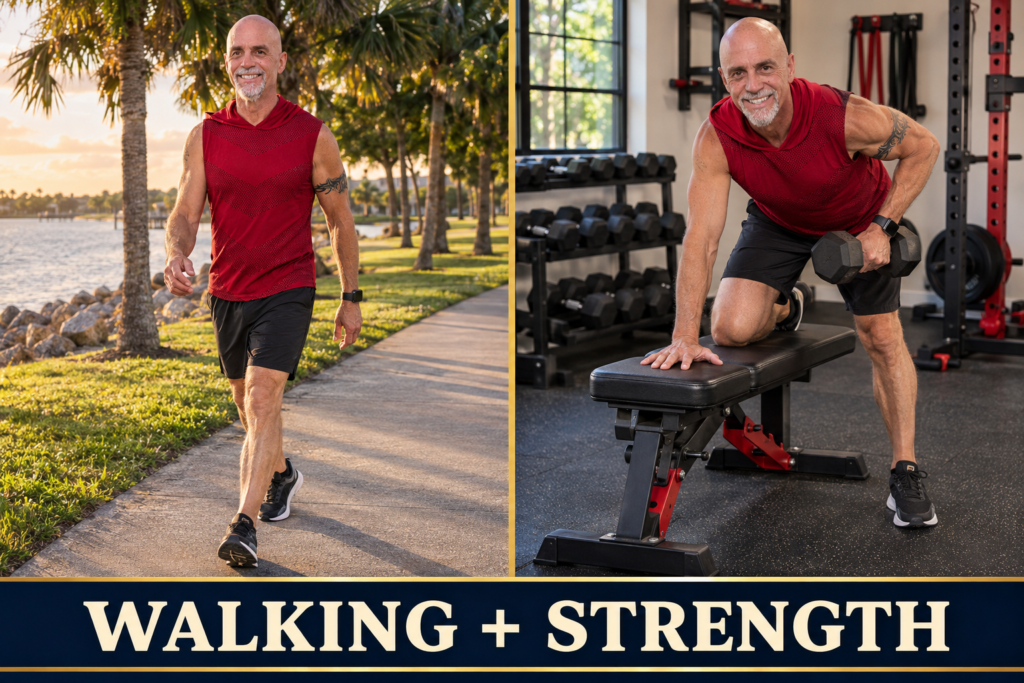
Is walking enough exercise after 50? Walking can cover much of your aerobic work if you do it briskly and consistently. However, walking alone usually does not provide enough strength, power, or balance training for a complete fitness plan.
The practical answer is simple: keep walking, add two full-body strength sessions each week, and include a little balance work.
Walking is not the problem. Asking walking to do every job is the problem.
Brisk walking is one of the easiest ways to improve your weekly activity without joining a gym, learning complicated exercises, or dressing like you are about to qualify for the Olympics. It is affordable, scalable, and easy to repeat. Those are major advantages after 50.
Still, your body needs more than heart-and-lung endurance. You also need enough strength to get out of a low chair, climb stairs, carry groceries, control your body on uneven ground, and keep doing the things that make life off the clock worth enjoying.
Quick answer: Brisk walking can satisfy much of the aerobic recommendation. It does not replace resistance training or balance work.
Why Walking Is So Valuable After 50
Walking deserves more respect than it gets. You can do it almost anywhere, adjust the pace to your current ability, and recover from it more easily than from many higher-impact activities.
Current U.S. physical activity guidance recommends at least 150 to 300 minutes of moderate-intensity aerobic activity each week for adults, along with muscle-strengthening work on at least two days. Brisk walking can count toward that aerobic target.
A regular walking habit can help you:
- Increase your total weekly movement without complicated equipment
- Build cardiovascular endurance when the pace is brisk enough
- Break up long periods of sitting
- Create an active-recovery option between strength workouts
- Spend time outside and make exercise feel less like punishment
- Build the consistency that makes every other fitness goal easier
If you are currently inactive, a ten-minute walk is not too small to matter. It is a starting point. Federal guidelines specifically encourage inactive adults to begin with manageable amounts and build gradually.
If that is where you are today, start with how to start exercising again after 50 and make your first goal consistency rather than distance.
What Counts as a Brisk Walk?

Not every walk has to be hard. An easy stroll can reduce sitting time, loosen you up, and support recovery. But if you want a walk to count as moderate-intensity aerobic activity, the pace needs to challenge you a little.
The CDC’s talk test is a practical way to judge intensity. During moderate activity, you should be able to talk but not sing. You are breathing harder, your heart rate is higher, and the pace feels purposeful without becoming an all-out effort.
Use these simple categories:
- Easy walk: You can speak and sing comfortably. This is useful for movement and recovery.
- Brisk walk: You can talk in sentences, but singing would be difficult. This is generally moderate intensity.
- Hard walk: Talking requires shorter phrases. Hills, heat, speed, and your current fitness can all raise the effort.
The same pace does not feel the same to everyone. A speed that is easy for one man may be challenging for another. Use effort, breathing, and your own ability instead of trying to match somebody else’s number on a treadmill.
Where Walking Falls Short
Walking trains the body to walk. That is useful, but it is also specific.
A flat walk does not ask your upper body to push, pull, or carry much load. It may not challenge your legs enough to build or preserve the strength you need for harder everyday tasks.
The Physical Activity Guidelines note that muscle-strengthening work provides benefits that aerobic activity does not. Resistance exercises challenge muscles with more force than they are accustomed to handling. That is the signal walking often cannot provide on its own.
Walking alone may leave gaps in:
- Upper-body pushing and pulling strength
- Grip and carrying strength
- Leg and hip strength beyond the demands of normal walking
- The ability to produce force quickly when you need to catch yourself or climb
- Balance practice that deliberately challenges stability
- Movement through ranges you do not use during a normal stride
You do not need a bodybuilding routine to cover those gaps. A beginner strength-training routine at home for men over 50 can train the major movement patterns with a chair, dumbbells, resistance bands, or your body weight.
Is 30 Minutes of Walking a Day Enough After 50?
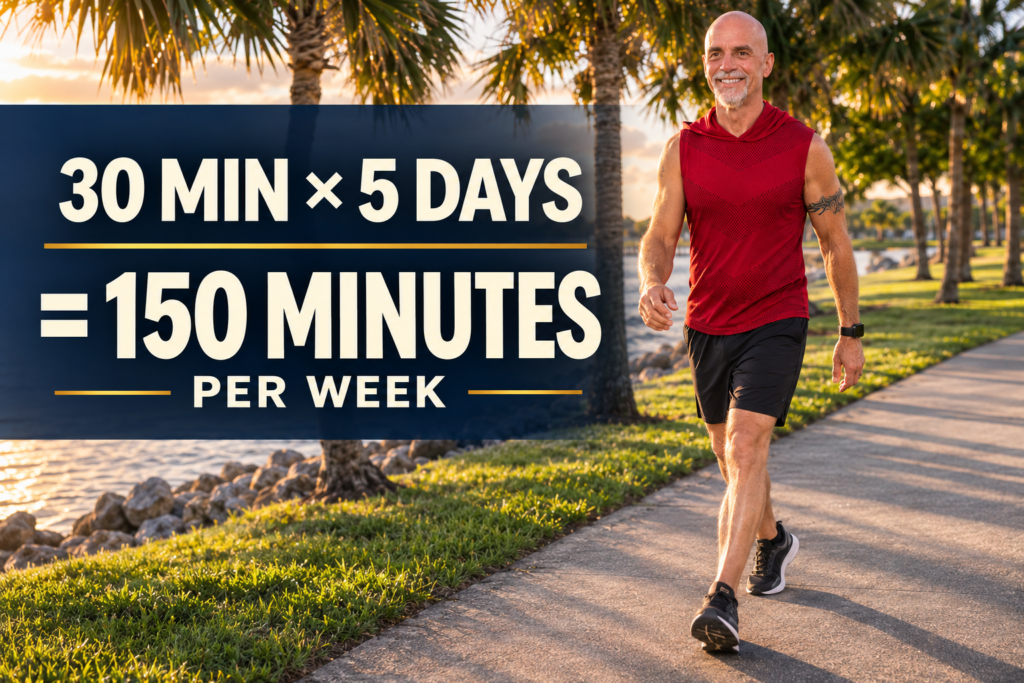
Thirty minutes of brisk walking on five days gives you 150 minutes of moderate aerobic activity. That meets the lower end of the weekly aerobic guideline for adults.
So, is thirty minutes a day enough?
It can be enough for the aerobic portion of your week. It is not the entire fitness plan because the same guidelines also call for muscle-strengthening work on at least two days. For adults 65 and older, federal guidance also specifically includes balance activity.
There is another important detail: pace matters.
Thirty minutes at an easy window-shopping pace is still movement, and movement is valuable. However, it may not reach moderate intensity.
You can solve that without turning the entire walk into misery. Add several brisk segments, use a mild hill, or gradually increase the pace as your fitness improves.
How Many Steps Should Men Over 50 Get?
There is no magic daily step number that every man over 50 must hit.
The familiar 10,000-step target can be motivating, but U.S. physical activity guidelines are written around weekly minutes and intensity—not a universal step minimum.
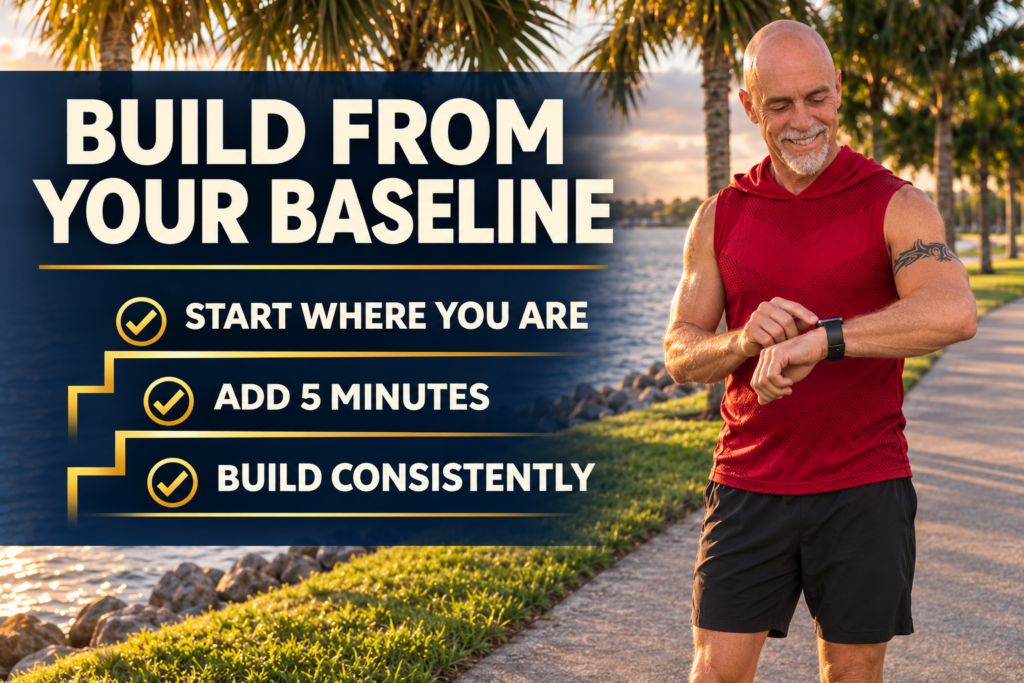
A better approach is to learn your current average and build from there.
If you average 4,000 steps, moving toward 5,000 or 6,000 may be a meaningful improvement. If you already average 8,000, you may benefit more from adding brisk intervals or strength work than from pacing around the kitchen at night to satisfy a watch.
A 2026 systematic review and meta-analysis of longitudinal studies in older adults found that higher habitual walking and additional daily steps were associated with favorable health outcomes, including lower mortality risk.
That is encouraging, but it does not establish one perfect threshold for every person.
Track steps if they help you move more. Do not let the number turn a useful habit into a nightly guilt contest.
Walking Versus Strength Training After 50
Walking and strength training are not opponents. They solve different problems, and a useful plan needs both.
Brisk walking
- Improves heart and lung endurance
- Increases your weekly movement
- Does not fully replace strength, power, upper-body work, or deliberate balance practice
Strength training
- Develops muscle strength
- Trains carrying, pushing, pulling, squatting, and standing
- Does not fully replace aerobic activity and regular low-intensity movement
Balance practice
- Develops stability and body control
- Improves confidence on uneven ground
- Does not replace strength or aerobic conditioning by itself
If you enjoy walking, keep it. The goal is not to replace your favorite activity with a complicated gym schedule. The goal is to protect the things walking does not train well.
A Simple Weekly Plan That Uses Both
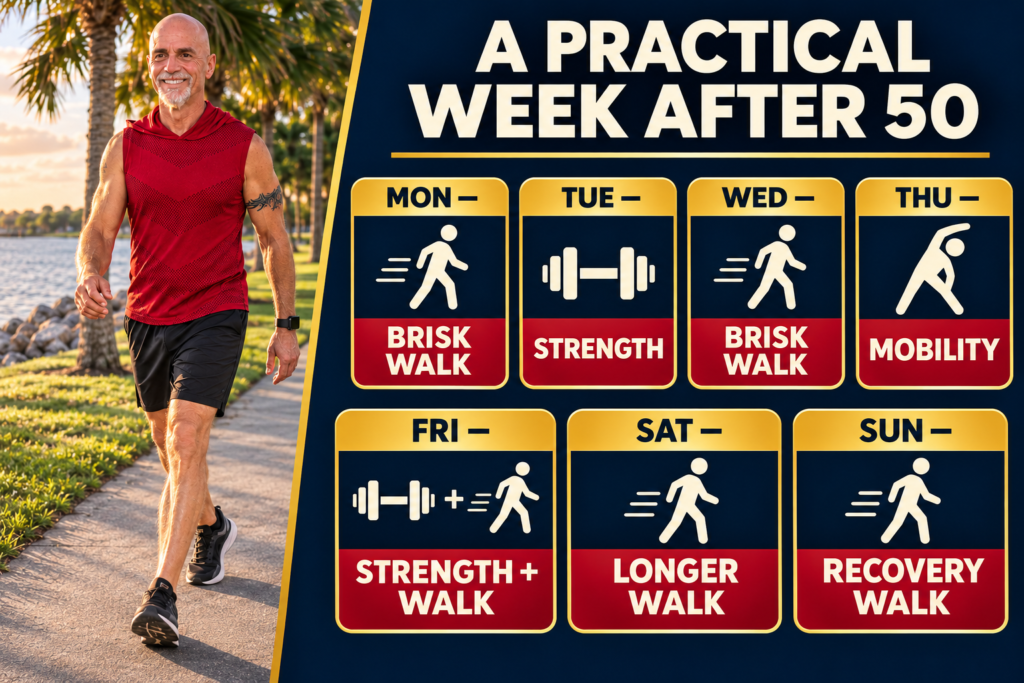
You do not need to exercise hard every day. A practical week can alternate strength work, brisk walking, easier movement, and recovery.
Monday: Full-body strength workout
Purpose: Train the major muscle groups
Tuesday: 20- to 30-minute brisk walk
Purpose: Aerobic work
Wednesday: Easy walk or mobility work
Purpose: Recovery and movement
Thursday: Full-body strength workout
Purpose: Repeat the major movement patterns
Friday: 20- to 30-minute brisk walk
Purpose: Aerobic work
Saturday: Longer easy walk or recreational activity
Purpose: Enjoyable movement and optional balance work
Sunday: Rest or take a short, easy walk
Purpose: Recover and prepare for the next week
Move the days to fit your schedule. The larger principle matters more than the calendar.
For a deeper explanation of recovery and frequency, read how often men over 50 should strength train.
How to Make Walking More Effective Without Turning It Into Punishment
Once easy walks feel comfortable, you can make some sessions more productive without running or beating up your joints.
- Use the talk test. Build toward a pace where you can talk but not sing.
- Add short brisk intervals. Try one minute brisk followed by two minutes easy for six rounds.
- Use gentle hills. A mild incline can raise the effort without requiring a faster stride.
- Vary the route. Different surfaces and turns can add variety, but choose safe, well-lit paths.
- Stand tall. Keep your head level, shoulders relaxed, and stride natural instead of reaching too far forward.
- Progress one thing at a time. Add a few minutes, a little speed, or a small incline—not all three during the same week.
You do not need ankle weights, an extreme incline, or a weighted vest to make walking count. Those tools change the load and may change your gait.
Build a reliable walking habit first. If you later want to add load, make sure it fits your current health, joints, and experience.
When to Take It Easier or Ask for Medical Advice
Normal effort can include faster breathing, warmth, and mild fatigue.
Sharp pain, chest pressure, fainting, or severe and unusual shortness of breath is different. Stop the activity and seek appropriate medical care.
The National Institute on Aging recommends increasing activity gradually. If you have a chronic condition, an existing injury, significant balance problems, or concerns about symptoms, discuss your plan with your clinician or physical therapist.
Use the next-day test too.
If a walk repeatedly leaves you limping, changes your normal movement, or causes joint pain that does not settle, reduce the distance or intensity and address the problem instead of trying to out-stubborn it.
Common Walking Mistakes Men Over 50 Make
Treating Walking as the Entire Program
Walking is excellent aerobic activity. It still leaves strength and balance gaps. Two short full-body sessions can make the weekly plan far more complete.
Chasing 10,000 Steps at Any Cost
A step goal should encourage movement, not force you to ignore pain, sleep, weather, or recovery. Improve your average instead of worshipping one number.
Walking at the Same Easy Pace Forever
Easy walks remain useful. However, if every walk is effortless and your goal is aerobic fitness, add controlled brisk segments rather than simply adding more slow minutes.
Doing Too Much Too Soon
Going from almost no walking to five long sessions in one week is a fine way to make your feet, calves, or knees angry. Increase gradually and let your body adapt.
Ignoring Strength Because Walking Feels Productive
Walking often feels productive because your watch records distance and steps. Strength work may produce fewer flashy numbers, but it trains abilities your step count cannot measure.
Is Walking Enough Exercise After 50? FAQs
Is walking enough exercise after 50?
Walking can be enough to meet much of your aerobic activity goal if the pace and weekly duration are sufficient.
It is not a complete program by itself because adults also need muscle-strengthening activity, and balance work becomes increasingly important with age.
Is 30 minutes of walking every day enough?
Thirty minutes of brisk walking on five days provides 150 minutes of moderate aerobic activity.
That meets the minimum aerobic guideline, but you should still add strength training on at least two days and include balance practice.
Does walking build muscle after 50?
Walking can strengthen previously inactive legs to a point, especially when you walk on hills or stairs.
However, normal walking usually does not provide enough progressive resistance to build or preserve strength across all the major muscle groups.
Should men over 50 walk every day?
Many men can walk daily when most walks are comfortable and recovery is good.
You do not have to walk every day. Weekly consistency matters more than maintaining a perfect streak, and easier days can support recovery from strength workouts.
Is walking or strength training better after 50?
Neither replaces the other.
Walking is better suited to aerobic activity and daily movement. Strength training is better suited to maintaining or improving muscle strength, carrying capacity, and the ability to push, pull, squat, and rise.
How fast should I walk for exercise?
A practical moderate pace lets you talk but makes singing difficult.
Your exact speed will depend on your current fitness, terrain, weather, and health. Use effort and breathing rather than chasing one universal miles-per-hour target.
The Final Answer
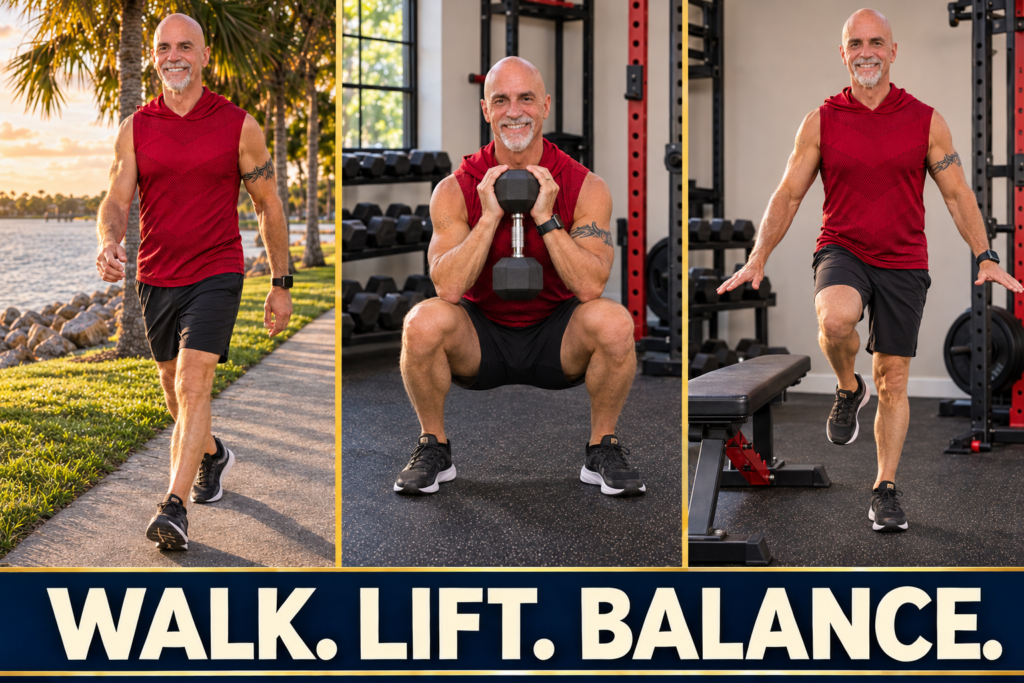
Is walking enough exercise after 50?
It is enough to be a very good start, and brisk walking can handle much of the aerobic portion of a healthy week. It is not enough to train every physical quality that matters after 50.
Keep walking. Add two full-body strength sessions. Practice balance for a few minutes several times per week.
That combination covers more of real life without turning your schedule into a second job.
If you want practical one-to-one help building that routine, visit Fitness After 50 or book a free 15-minute fitness intro call. We can talk about your goals, available equipment, and a sensible place to begin.
Safety note: This article provides general educational information and is not a diagnosis or individualized medical advice.
Sources
- U.S. Department of Health and Human Services — Physical Activity Guidelines Questions and Answers
- CDC — Adult Physical Activity
- CDC — Older Adult Activity Overview
- National Institute on Aging — Tips for Getting and Staying Active
- PubMed — Walking and Health Outcomes in Older Adults

Eric Webber is the founder of Bathrobe Patriot, a former chef and restaurant owner, and a Florida guy who believes life after 50 should include good food, regular movement, and time worth enjoying. He shares bourbon and cigar reviews, practical cooking, and the habits that helped him lose 50 pounds. His approach is simple: real food, consistency, common sense, and making room for life off the clock.