
Grab your coffee, America. It’s almost June 14, 2026, and if you’re like most Bathrobe Patriots, you’ve already got Old Glory flying out front or draped over the back porch railing. But do you know the full history of Flag Day? Not the watered-down version from school assemblies—this is the real story: how a simple resolution in 1777 turned into a nationwide day of pride, why a Wisconsin schoolteacher became the “Father of Flag Day,” and why this date still fires up everyday patriots like us in 2026.
Flag Day isn’t a federal holiday with paid time off (sorry, no three-day weekend), but it kicks off National Flag Week and packs a double patriotic punch. It’s the birthday of the Stars and Stripes and the U.S. Army. In a year when America is gearing up for its 250th anniversary celebrations, there’s never been a better time to dig into the Flag Day facts, origin story, and simple ways to honor it right from your couch.
Stick with me through this no-BS guide. By the end, you’ll know exactly when is Flag Day, why we celebrate Flag Day, and how to fly the flag like a pro—whether you’re in your bathrobe or boots on the ground. Let’s get into it. 🇺🇸
What Is Flag Day?
Flag Day is the annual American observance held on June 14 to honor the adoption of the Stars and Stripes as the official flag of the United States. On June 14, 1777, the Second Continental Congress approved the basic design of the flag: thirteen stripes, alternating red and white, with thirteen white stars in a blue field representing a “new constellation.”
Unlike Independence Day, Flag Day usually doesn’t come with fireworks, cookouts, or a long weekend. But that’s exactly why it matters. It gives Americans a quieter moment to reflect on the symbol itself: the flag that has flown over battlefields, schools, front porches, small towns, military bases, ballparks, and every kind of American home.
For the Bathrobe Patriot, Flag Day is simple. You don’t need a parade invitation or a government ceremony. Raise the flag, know the story, teach the meaning, and remember that June 14 marks one of the most important visual symbols in American history.
The Origins of Memorial Day: Post-Civil War Grief and the Birth of Decoration Day
Why June 14 Was Chosen for Flag Day
June 14 was not picked randomly. It goes directly back to the day in 1777 when Congress approved the first official national flag during the Revolutionary War. That resolution gave the new nation a visual identity at a time when America was still fighting to become a country in the first place.
That’s what makes Flag Day different from a generic patriotic holiday. It is not just about waving red, white, and blue because it looks good on the porch. It is about remembering the exact moment America chose a symbol to represent thirteen colonies trying to become one nation.
In 2026, that history carries even more weight. America250 marks the 250th anniversary of the signing of the Declaration of Independence on July 4, 2026, making Flag Day a perfect lead-in to a bigger national reflection on where the country started and where it goes next.
What Happened on June 14, 1777? The Birth of Old Glory
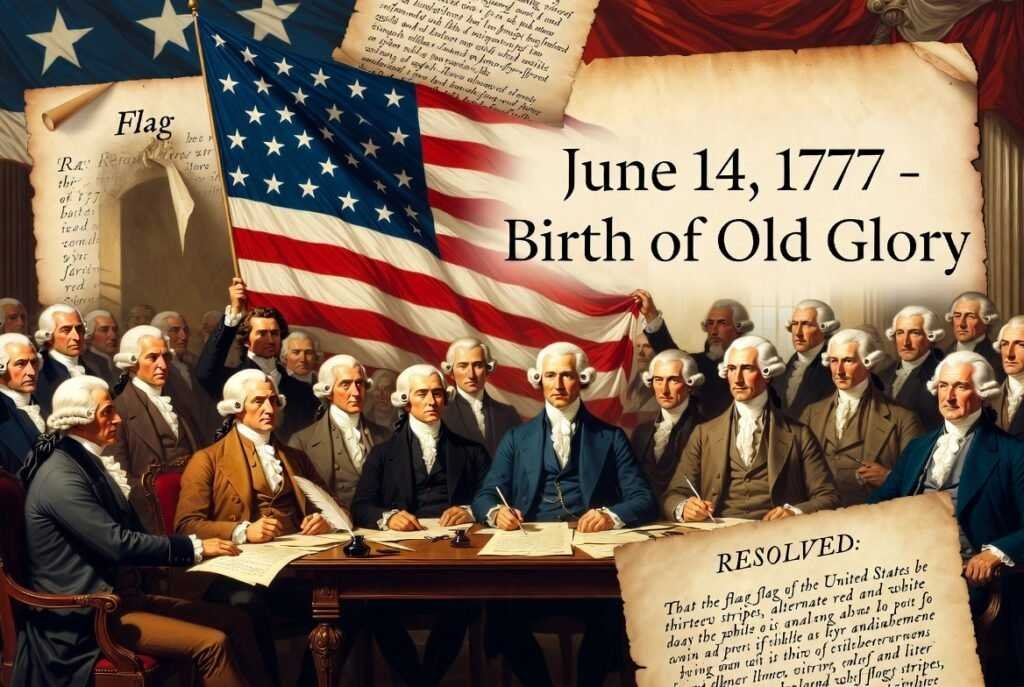
The Flag Day origin starts right here, in the heat of the Revolutionary War. On June 14, 1777, the Second Continental Congress passed a short but game-changing resolution in Philadelphia:
“Resolved, That the flag of the thirteen United States be thirteen stripes, alternate red and white; that the union be thirteen stars, white in a blue field, representing a new constellation.”
That’s it. No fireworks, no grand ceremony—just a quiet vote that gave birth to the Stars and Stripes. This wasn’t some random design committee either. The flag was meant to symbolize the brand-new United States as a “new constellation” rising in the world. Thirteen colonies, thirteen stripes, thirteen stars. Simple. Powerful. Permanent.
No official designer is named in the resolution (sorry, Betsy Ross fans—the popular legend has heart but shaky primary-source proof). What we do know is that this flag first flew into battle just a few months later at the Battle of Brandywine and earned its first foreign salute in 1778.
Fast-forward to Flag Day 2026 and that same design principle still holds: the flag has evolved with every new state, but the core—red, white, blue, stripes, stars—remains unchanged. It’s the visual shorthand for everything the Revolution fought for: unity, independence, and a government by the people.
If you want the full original text and context, check out the National Archives’ take on the Flag Resolution or the detailed history from the National Flag Day Foundation.
Why We Celebrate Flag Day – From Local Schoolrooms to National Recognition

The history of Flag Day didn’t happen overnight. For a full century after 1777, Americans mostly celebrated the flag on the Fourth of July. Then a determined schoolteacher changed everything.
Enter Bernard J. Cigrand—the man widely called the “Father of Flag Day.” In 1885, as a 19-year-old teacher at Stony Hill School in Waubeka, Wisconsin, Cigrand placed a small 38-star flag in a bottle on his desk and asked his students to honor the flag’s birthday on June 14. He didn’t stop there. He spent decades writing articles, giving over 2,000 speeches, and lobbying Congress through the National Flag Day Association.
By 1916, President Woodrow Wilson issued the first national proclamation urging Americans to observe June 14 as Flag Day. In 1949, President Harry S. Truman signed an Act of Congress that made it official: June 14 would forever mark the anniversary of the 1777 Flag Resolution.
How Flag Day Became Official
Flag Day started as a grassroots idea before it became a national observance. Bernard J. Cigrand pushed the idea for decades, but the federal recognition came in stages. President Woodrow Wilson issued a proclamation in 1916 recognizing June 14 as Flag Day, and Congress later made the observance official in 1949 when President Harry S. Truman signed it into law.
That slow path is part of the story. Flag Day did not become meaningful because Washington forced it onto the calendar. It became meaningful because teachers, veterans, civic groups, families, and patriotic communities kept the tradition alive until the country officially recognized what many Americans were already doing.
That makes Flag Day feel more personal than political. It grew from the bottom up, from classrooms and local celebrations into a national reminder that the flag belongs to the people.
It’s not a federal holiday—no mail delivery pause, no bank closures—but the law asks every president to issue a yearly proclamation and encourages all of us to display the flag. That’s the Bathrobe Patriot spirit: no government mandate required, just genuine respect.
Cigrand’s hometown of Waubeka still hosts one of the biggest Flag Day celebrations every year. In 2026 the National Flag Day Foundation is going all out with events tied to America’s 250th anniversary. If you’re ever in Wisconsin on June 14, it’s worth the road trip.
Flag Day Facts Every Bathrobe Patriot Should Know
Here’s the good stuff—Flag Day facts you can drop at the backyard BBQ or share with the kids while they’re still half-asleep in their PJs:
- Double holiday: June 14, 1775—exactly two years before the flag resolution—the Continental Congress authorized the Continental Army. That’s why Flag Day is also the official U.S. Army birthday. Talk about layered patriotism.
- 27 official versions: The flag has been updated 27 times as states joined the Union. The current 50-star design has flown the longest.
- Teen designer wins: In 1958, 17-year-old Robert “Bob” Heft from Ohio turned his mom’s sewing machine and a 48-star flag into a 50-star prototype for a high-school history project. He got a B-minus… until President Eisenhower chose it in 1959. The 50-star flag first flew officially on July 4, 1960.
- Color symbolism that still hits: Red = hardiness and valor; White = purity and innocence; Blue = vigilance, perseverance, and justice. Every thread tells a story.
- Not just stars and stripes: The “union” (blue field) represents the union of states. The stars are arranged in rows, but the exact pattern has varied over time.
- First foreign salute: February 14, 1778, when the French saluted the Stars and Stripes aboard John Paul Jones’s ship Ranger.
- 100th anniversary kickoff: The first widespread national observance happened in 1877—exactly 100 years after the resolution.
- Modern twist for 2026: With America250 celebrations ramping up, expect more flag displays, school programs, and community events than usual.
These aren’t dusty textbook facts—they’re the reason your porch flag still means something in 2026.
The Ultimate Guide to the Best Bourbons for Cocktails (Old Fashioned, Manhattan & More)
Flag Day and the U.S. Army Birthday
One of the most overlooked Flag Day facts is that June 14 also marks the birthday of the United States Army. On June 14, 1775, the Continental Congress authorized the first companies of riflemen to serve the United Colonies, creating what became the U.S. Army.
That means June 14 carries two major American milestones: the birth of the Army in 1775 and the adoption of the flag in 1777. One represents the force created to defend the young nation. The other represents the symbol that would eventually fly over it.
For veterans, military families, and everyday Americans who respect service, that double meaning gives Flag Day extra weight. It is not just a flag-on-the-porch day. It is also a day to remember the men and women who have defended what that flag represents.
How the American Flag Has Evolved – 1777 to Flag Day 2026
The flag isn’t frozen in 1777. It’s grown with the country:
- 1795: 15 stars and 15 stripes (Vermont + Kentucky).
- 1818: Congress fixes stripes at 13 forever and adds a star for each new state.
- 1912: President Taft standardizes proportions and star arrangement.
- 1959-1960: Alaska and Hawaii push us to 49 then 50 stars—Bob Heft’s design wins.
Today’s flag has flown longer than any previous version. In Flag Day 2026, as we edge closer to the 250th anniversary of the Declaration of Independence, that evolution feels especially meaningful. It reminds us the country is still expanding, still striving, still one nation under the same stars.
Want a deeper dive? Read the full flag history timeline at the National Flag Foundation.
What the American Flag Represents Today
The American flag has changed as the country has grown, but the basic message has stayed the same. The thirteen stripes still point back to the original colonies. The stars still represent the states. The blue field still symbolizes the union that holds them together.
But in real life, the flag means different things to different Americans. For some, it represents military service. For others, it represents citizenship, sacrifice, family history, freedom, opportunity, or simply the front-porch pride of being part of this country.
That is why Flag Day still matters. You do not have to agree with every politician, every policy, or every headline to respect the flag. The flag is bigger than the daily noise. It points back to the idea that Americans are still part of one national story, even when we argue about the next chapter.
Flag Etiquette & Easy Ways to Celebrate Flag Day at Home

Knowing the history of Flag Day is one thing—living it is better. Here’s how every Bathrobe Patriot can do it right:
Display rules (straight from the U.S. Flag Code):
- Fly from sunrise to sunset (or 24/7 if properly illuminated at night).
- Union (stars) always upper left when displayed horizontally or vertically.
- Never let it touch the ground.
- Half-staff only for official mourning periods (and only after it’s first raised fully).
- On the same pole with other flags? U.S. flag always at the top.
Bathrobe-friendly celebration ideas for Flag Day 2026:
- Morning flag raising – Step outside in your robe, raise Old Glory, and say the Pledge.
- Teach the kids – Print the 1777 resolution and discuss what “new constellation” really means.
- Flag-themed dinner – Red-white-blue everything. Bonus points for telling the Bob Heft story over dessert.
- Virtual parade – Watch the Waubeka celebration live or stream military band performances.
- Proper folding – Learn the 13-fold military ceremony. (Internal link: How to Fold the American Flag Like a Pro)
Pro tip: If you need replacement flags or accessories, support American-made companies—check our recommended flag suppliers here.
For the official rules, bookmark the American Legion’s Flag Code page or the VFW Flag Etiquette guide.
Simple Flag Day 2026 Ideas for Families
Flag Day does not need to be complicated. You can make it meaningful with a few simple traditions at home.
Start the morning by raising the flag and explaining to your kids or grandkids why June 14 matters. Keep it short and real: this is the day America adopted its national flag during the Revolutionary War.
You can also read the Pledge of Allegiance, watch a short video about the history of the flag, visit a local veterans memorial, or teach the proper way to fold the flag. If you have an older flag that is worn or damaged, contact a local VFW, American Legion post, scout troop, or veterans group about proper retirement.
For a Bathrobe Patriot-style celebration, keep it simple: coffee on the porch, Old Glory in the breeze, and a five-minute history lesson that actually sticks.
Why the History of Flag Day Still Matters in 2026
Look, in a world of endless notifications and political noise, Flag Day cuts through. It’s not about perfection—it’s about remembering that 13 ragtag colonies became the greatest experiment in self-government the world has ever seen. The flag isn’t just cloth; it’s a promise kept for 249 years and counting.
As we roll into America’s 250th anniversary year, flying the flag on June 14 isn’t nostalgia—it’s participation. It’s saying, “I’m still in this with you, America.” Whether you’re a veteran, a new citizen, a kid learning the Pledge, or just a regular guy sipping coffee in his bathrobe, the Stars and Stripes belongs to all of us.
So this Flag Day 2026, make it count. Raise it high, teach the story, and live the values.
Final Thought: Flag Day Is Small, But It Still Matters
Flag Day may not be loud. It may not come with fireworks, paid time off, or a giant national countdown. But that is part of its strength.
It is a simple reminder that the American flag did not appear out of nowhere. It came from a moment of risk, rebellion, and belief. Thirteen colonies needed a symbol, and that symbol grew with the country.
So when June 14, 2026 rolls around, do not let it pass like just another square on the calendar. Raise the flag. Tell the story. Fix the old porch bracket. Replace the faded flag. Teach one kid what the stars and stripes mean.
That is how traditions survive.
Ready to fly it proud? Share this post with your crew, sign up for more straight-talking patriotic reads below, and check out our other guides:
- What Every Symbol on the American Flag Really Means
- Patriotic Holidays Every American Should Know
- How to Host a Backyard Flag Day BBQ
Fly it high, America. See you on the porch.
FAQ – Quick Answers to Common Flag Day Searches
Flag Day 2026 is Sunday, June 14, 2026. Flag Day is always observed on June 14 every year, no matter what day of the week it falls on.
No. Flag Day honors the adoption of the American flag on June 14, 1777. Independence Day, celebrated on July 4, honors the adoption of the Declaration of Independence in 1776.
Flag Day 2026 matters because it falls during America’s 250th anniversary year. The country will be focused on its founding history, and Flag Day gives Americans a chance to reflect on one of the nation’s most recognizable symbols before the July 4 semiquincentennial celebration.
No. Flag Day is a national observance, but it is not a federal holiday with automatic time off, closed banks, or suspended mail service. Congress designated June 14 as Flag Day in 1949 and requested annual presidential proclamations encouraging Americans to display the flag.
Contact your local VFW, American Legion, or Boy Scout troop for a dignified retirement ceremony.

Eric Webber is the founder of Bathrobe Patriot, a lifestyle brand centered on bourbon, cigars, and common sense. As an ISSA-certified trainer and former restaurant owner with 20 years of experience, he values quality over quantity and backbone over political correctness. Currently, Eric lives in Safety Harbor, Florida, where he advocates for a life of balance, discipline, and the occasional slow pour. Consequently, his mission is to provide you with the unfiltered truth about the gear, spirits, and culture that define the American spirit.