
Football weekend should not mean spending the entire game standing over a grill while everybody else eats your food, drinks your bourbon, and yells at the television. With the right Football Weekend Grilling Timeline, you can enjoy the fun and the food without missing out on the action.
The best football weekends are planned before kickoff.
That does not mean turning Sunday into a military operation with spreadsheets, color-coded coolers, and a laminated depth chart for the hamburgers.
It means knowing what you can prep ahead, when to light the grill, what should cook first, what should wait until halftime, and how to get hot food in front of everybody without missing half the game.
After years working as a professional chef and restaurant owner, I learned one thing about feeding a crowd:
Cooking is usually the easy part. Timing is what separates an organized meal from complete chaos.
The same thing applies to football Sunday.
This football weekend grilling timeline gives you a simple game-day cooking schedule for burgers, chicken wings, steaks, sausages, vegetables, appetizers, and other football food.
Whether you are cooking for four people on the patio or hosting a full football watch party, the goal is the same:
Do most of the work before kickoff. Cook in waves. And sit down long enough to actually watch the damn game.
Need the whole weekend plan instead of just the cooking schedule? Start with the Football Weekend Playbook for food, bourbon, cigars and the complete game-day setup.
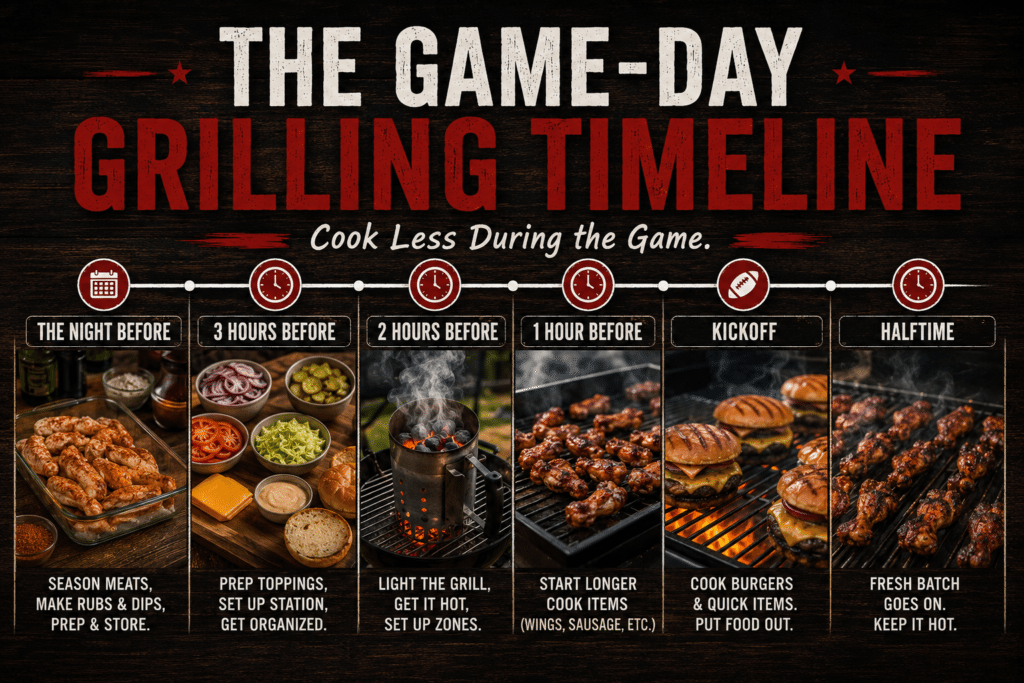
Quick Answer: What Is the Best Football Sunday Grilling Timeline?
For a typical 1:00 PM kickoff, start your football grilling timeline the day before by shopping, preparing sauces and seasonings, trimming meat, and organizing cold ingredients.
On game day, begin serious prep about three hours before kickoff. Have cold dishes completed roughly two hours before the game, preheat the grill 45 to 60 minutes before cooking, and aim to have the first hot food ready approximately 15 to 30 minutes before kickoff.
A simple schedule looks like this:
| Time | What to Do |
|---|---|
| Saturday | Shop, season, make dips, prep vegetables |
| 9:30 AM | Organize kitchen and outdoor cooking area |
| 10:00 AM | Prep burgers, wings and toppings |
| 10:30 AM | Finish cold dishes and appetizers |
| 11:00 AM | Set up drinks, serving area and equipment |
| 11:30 AM | Preheat grill/griddle as appropriate |
| Noon | Begin longer-cooking items |
| 12:15–12:30 PM | Cook first round of wings/burgers |
| 12:45 PM | Put out first hot food |
| 1:00 PM | Kickoff |
| Halftime | Cook or reheat second wave |
| After game | Refrigerate leftovers and clean up |
The exact timing changes according to what you are cooking.
The whole point is buying back the rest of the day. Once the prep is handled, here are 15 better things to do on Saturday than standing in the kitchen waiting for kickoff.
The important principle is simple:
Do not make kickoff your cooking deadline. Make kickoff your sitting-down deadline.
The Ultimate Football Weekend Checklist: Everything You Need Before Kickoff
Why You Need a Football Weekend Grilling Timeline
Most bad game-day cooking does not happen because somebody cannot grill a hamburger.
It happens because everything needs attention at the same time.
The burgers need flipping.
Somebody wants another batch of wings.
The bacon is burning.
The buns still need toasting.
Nobody can find the mustard.
Your buddy has opened the grill lid six times because apparently he has recently become the executive chef.
Meanwhile, your team just scored and you saw none of it.
A good game-day cooking schedule moves as many jobs as possible away from kickoff.
There are really three categories of football food:
Food You Can Prepare Ahead
Examples include:
- Dry rubs
- Dips
- Salsa
- Guacamole prepared close enough to serving
- Cut vegetables
- Burger toppings
- Pickles
- Sauces
- Deviled eggs
- Cold salads
- Seasoned wings
- Portion-controlled burger meat
Food That Should Be Cooked Before Kickoff
Examples include:
- First batch of wings
- Sausages
- Hot dogs
- Grilled vegetables
- Some appetizers
- Bacon
- Chili
- Slow-cooked meats
Food That Is Best Cooked Close to Serving
Examples include:
- Smashburgers
- Thick burgers
- Steaks
- Toasted buns
- Certain grilled seafood
- Final batches of wings
Once you divide the menu this way, football Sunday becomes considerably easier.
The No-BS Rule: Build the Menu Around the Game
Do not choose seven dishes and then figure out how you are going to cook them.
Start with the game.
Then build the menu.
If kickoff is at 1:00 PM, ask:
What needs to be ready by 12:45?
If you are watching games from noon until midnight, ask:
What can I serve in waves?
If you have people arriving an hour before kickoff, ask:
What can they eat while the main food cooks?
That is the foundation of a useful football party food timeline.
And you do not need twelve entrées.
For most football gatherings, I would build the menu around:
One main + one secondary item + two easy sides + one snack.
For example:
Main: Smashburgers
Secondary: Dry-rub wings
Sides: Vegetables and sweet potato wedges
Snack: Guacamole and vegetables
Now you have a football spread instead of a restaurant menu.
Friday: Make the Football Weekend Plan
Yes, football Sunday preparation can start Friday.
Not by cooking.
By deciding what the hell you are doing.
Friday is when I would answer five questions:
- How many people are coming?
- What time is kickoff?
- What am I cooking?
- What equipment do I need?
- What can I prepare Saturday?
This takes ten minutes and can save an hour of stupidity Sunday morning.
Check:
- Propane
- Charcoal
- Pellets
- Griddle fuel
- Meat thermometer
- Grill tools
- Foil
- Paper towels
- Serving trays
- Ice
- Cooler space
Running out of propane with twelve raw burgers and eight hungry people staring at you is an avoidable problem.
Friday Night Beverage Check
This is also when I would check the beverage situation.
For bourbon ideas, use my Best Bourbon for Football Sunday guide.
If you are stocking the bar without spending a fortune, the Best Bourbons Under $50 guide gives you plenty of affordable options.
And remember:
The cook gets first dibs on the bourbon after the dangerous knife-and-fire portion of the program is under control.
Good weekends usually aren’t complicated. They just need fewer dumb decisions. That’s the same idea behind my No-BS Guide to Having a Better Weekend.
Saturday: Do the Work That Nobody Needs to See
Saturday is where you win Sunday.
Every job you complete Saturday is one less job competing with football the next day.
Saturday Morning: Shop
Buy:
- Meat
- Chicken
- Burger ingredients
- Vegetables
- Fruit
- Herbs
- Ice
- Beverages
- Condiments
- Charcoal or propane if necessary
- Disposable supplies if you use them
Do not make Sunday morning your major grocery-shopping trip unless you enjoy discovering that everybody in town apparently decided to buy chicken wings at the same time.
Saturday Afternoon: Make Your Rubs and Sauces
Mix dry rubs now.
Prepare dips that hold well overnight.
Make burger sauce.
Mix marinades where appropriate.
Wash and cut sturdy vegetables.
Organize everything in labeled containers.
If wings are part of the menu, this is the perfect time to choose a seasoning from my Healthy Football Wings guide.
That article includes ten different Paleo dry rubs, including Nashville heat, citrus pepper, Cajun, smoky BBQ, lemon herb, and coffee-cocoa smoke.
Saturday Night: Prep the Meat
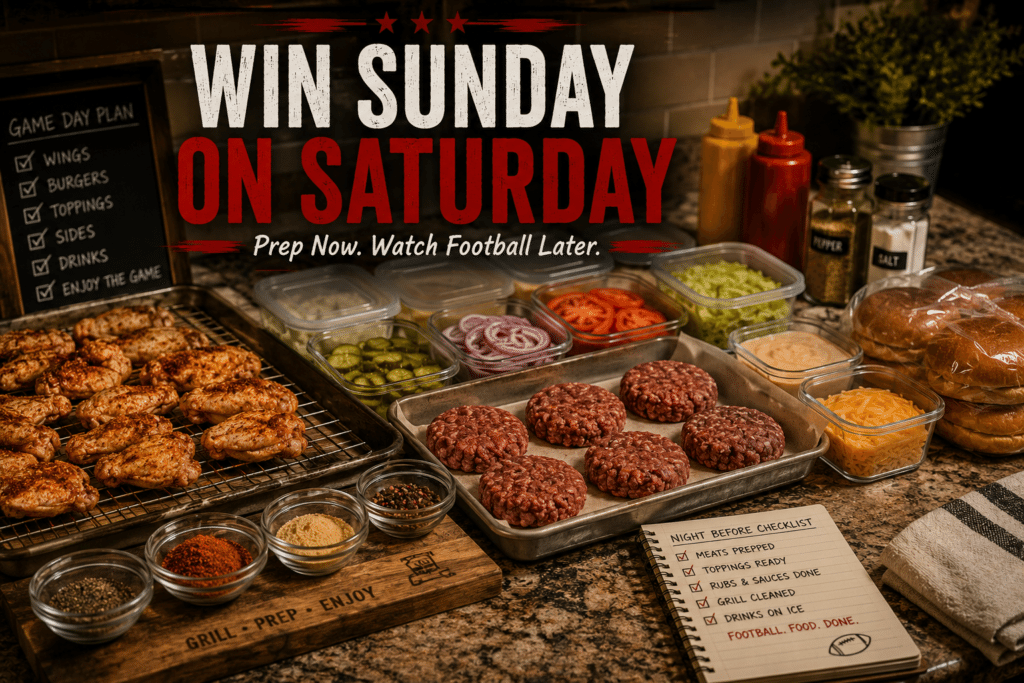
There is a difference between prep ahead and cook everything ahead.
I would not cook Sunday smashburgers Saturday night.
But you can portion the beef.
If you are making smashburgers, portion loose balls of ground beef and refrigerate them properly.
Do not smash them yet.
If you are grilling traditional patties, form them ahead and keep them cold.
For the complete burger method, see my Ultimate Football Burger Guide.
Prep Your Wings
Pat the wings thoroughly dry.
Season them.
Arrange them appropriately for refrigeration.
Getting surface moisture off chicken skin helps tremendously when you want crisp wings without breading or deep-frying.
Prep Steaks
Trim anything that needs trimming and organize the steaks so Sunday prep is simple.
Keep all raw meat properly refrigerated and separated from ready-to-eat food.
USDA food-safety guidance emphasizes keeping raw and cooked foods separate and using different platters, cutting boards, and utensils to prevent cross-contamination.
USDA Grilling Food Safely guidance
Sunday: The Football Game-Day Cooking Schedule
Now we get to the main event.
For this example, I am using a 1:00 PM kickoff.
If your game begins at 4:25 PM, simply move the schedule forward approximately three and a half hours.
For an 8:20 PM game, move it accordingly.
The sequence matters more than the clock.
9:30 AM — Get Organized
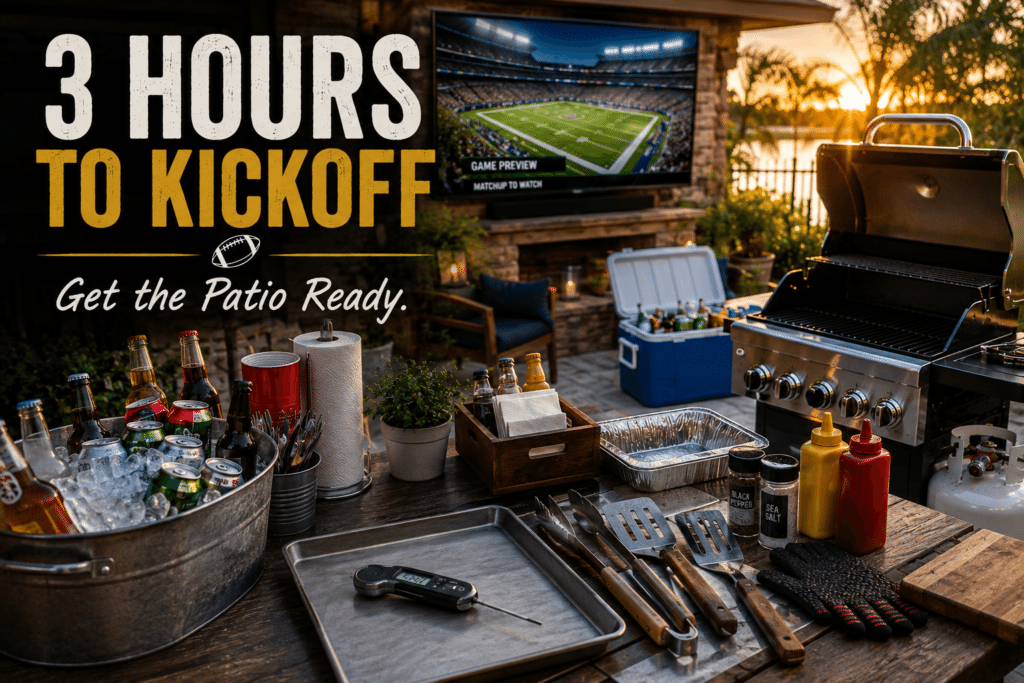
Do not start cooking.
Start organizing.
Clear the counters.
Empty the dishwasher.
Get serving platters ready.
Check the grill.
Check your fuel.
Put the instant-read thermometer somewhere you can actually find it.
Set out:
- Tongs
- Spatulas
- Sheet pans
- Cutting boards
- Serving dishes
- Foil
- Paper towels
- Trash bags
You are creating a workstation.
Professional kitchens call this mise en place.
Normal people call it not running around like an idiot later.
10:00 AM — Start Cold Prep
Now handle everything that does not require heat.
Slice:
- Tomatoes
- Onions
- Pickles
- Jalapeños
- Lettuce
- Citrus
Prepare:
- Burger toppings
- Wing dips
- Salsa
- Guacamole
- Vegetable trays
- Cold salads
If you did not mix it Saturday, this is also the window to make the base for my bourbon punch for a crowd. Refrigerate it now, keep the ginger beer separate and add the bubbles about 15 minutes before kickoff. Guests can serve themselves, and you are not playing bartender through the first quarter.
Return perishable ingredients to refrigeration rather than letting them sit on the counter for the next three hours.
10:30 AM — Portion and Stage the Meat
Get the meat organized.
That does not mean leaving raw meat outside until cooking time.
It means making sure everything is portioned, seasoned where appropriate, labeled, and easy to retrieve.
If you are serving multiple wing rubs, separate them now.
If you have 30 burgers, count the portions now.
If you are grilling sausages, know how many.
You do not want to discover halfway through cooking that six people invited six more people.
11:00 AM — Build the Game-Day Serving Station
Now get out of the kitchen.
Set up the football area.
You need a logical place for:
- Plates
- Napkins
- Forks
- Condiments
- Cold sides
- Water
- Ice
- Drinks
- Trash
Put burger toppings together.
Put wing dips together.
Put serving utensils where people can find them.
The objective is to make the party self-service.
You are hosting football Sunday.
You are not working the Sunday brunch shift.
11:15 AM — Set Up the Grill or Griddle
Inspect everything before lighting it.
For a gas grill:
Check fuel and clean the grates.
For charcoal:
Allow enough time for the charcoal to ignite and establish proper cooking zones.
For a pellet grill:
Make sure you actually have pellets.
For a flat-top:
Clean the surface and get your spatulas ready.
If you are cooking several foods, create hot and cooler zones rather than making every square inch of the grill maximum heat.
That gives you control.
11:30 AM — Preheat
Now we are cooking.
A properly preheated cooking surface makes everything easier.
This is particularly important for burgers.
A smashburger needs serious surface heat to develop that deep brown crust.
A thick grilled burger benefits from controlled heat.
Chicken wings may benefit from indirect cooking followed by a hotter finish.
The cooking method should match the food.
Noon — Start the Food That Takes the Longest
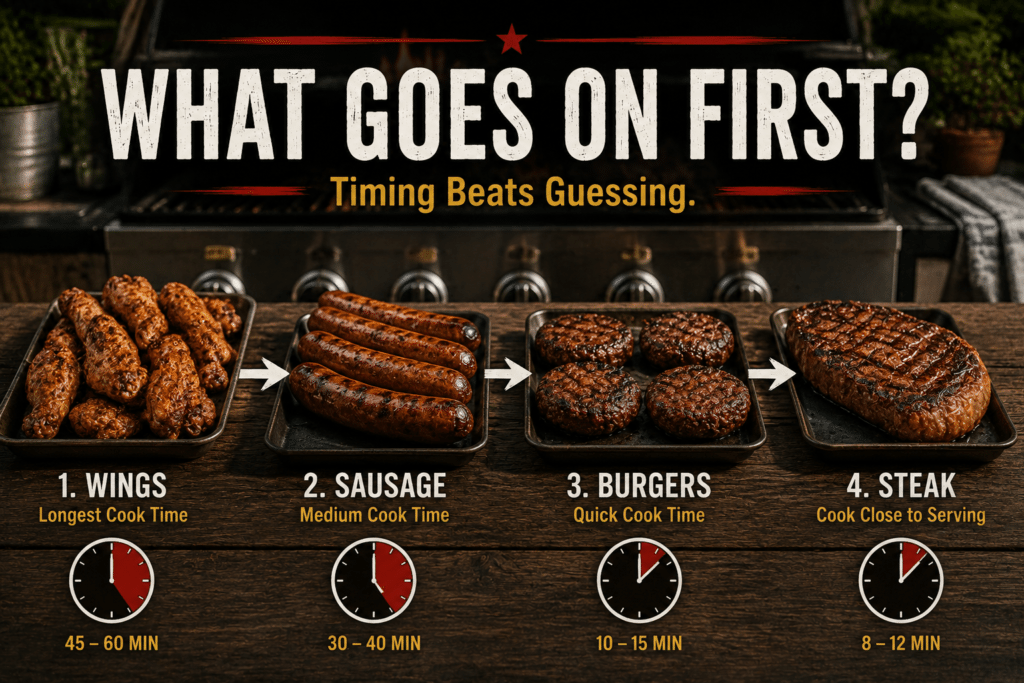
This is where your particular menu changes the schedule.
Wings
If wings need 30 to 50 minutes depending on the cooking method, start them first.
And remember: you do not need a deep fryer.
My football wings are designed around oven baking, air frying, grilling, smoking, and pellet grilling.
Sausages
These can usually begin before delicate foods.
Vegetables
Dense vegetables may need a head start.
Slow-Cooked Food
Pulled pork, brisket, chili, and similar dishes should already be well underway or essentially finished.
Do not decide at noon that you would like brisket for a 1:00 kickoff.
Even I cannot help you with that.
12:15 PM — First Burger Wave
If burgers are the main event, this is where the first batch can begin.
For a crowd, cook in waves.
Do not attempt to cook 25 burgers simultaneously unless your equipment genuinely accommodates 25 burgers.
Crowding causes problems.
The griddle temperature falls.
The grill becomes difficult to manage.
Burgers steam.
Everything finishes at different times.
Instead:
Batch 1: People eating before kickoff
Batch 2: Late arrivals / first quarter
Batch 3: Halftime if necessary
That system produces better burgers and considerably less stress.
12:30 PM — Finish and Toast
Your first major round of food should be approaching completion.
Now:
- Melt cheese
- Toast buns
- Crisp wings
- Finish vegetables
- Transfer cooked food to clean platters
- Add garnishes
- Put out hot food
Do not put cooked meat back onto a platter that held raw meat. USDA grilling guidance specifically warns against using the same platters or utensils for raw and cooked foods because of cross-contamination risk.
12:45 PM — Food Is Out
This is the target.
Fifteen minutes before kickoff.
People can build burgers.
Grab wings.
Get drinks.
Find seats.
You can clean the immediate cooking mess and get yourself situated.
At 1:00 PM, you should not be standing over twelve raw hamburger patties.
You should be sitting down.
1:00 PM — Kickoff
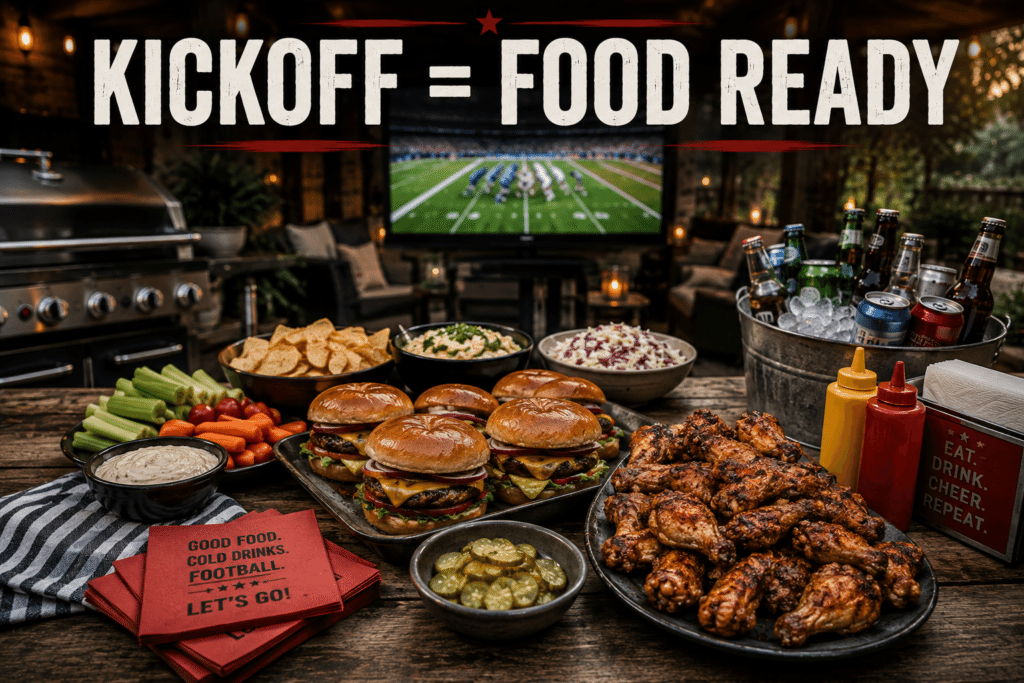
Kitchen closed.
Mostly.
This is why you prepared ahead.
You have food.
People have drinks.
The grill is under control.
And you get to watch the game.
First Quarter — Leave the Grill Alone
Unless you have food intentionally cooking, leave it alone.
This is where people make football hosting harder than necessary.
Nobody requires a freshly prepared entrée every 11 minutes.
Let people eat.
Watch football.
Have a conversation.
Your house is not a sports bar.
Second Quarter — Check the Food Situation
Commercial break.
Take inventory.
Are the wings disappearing?
Do you need another burger batch?
Are late guests arriving?
Is there enough ice?
This should take about two minutes.
If everybody is fed, sit back down.
Halftime — The Second Cooking Window
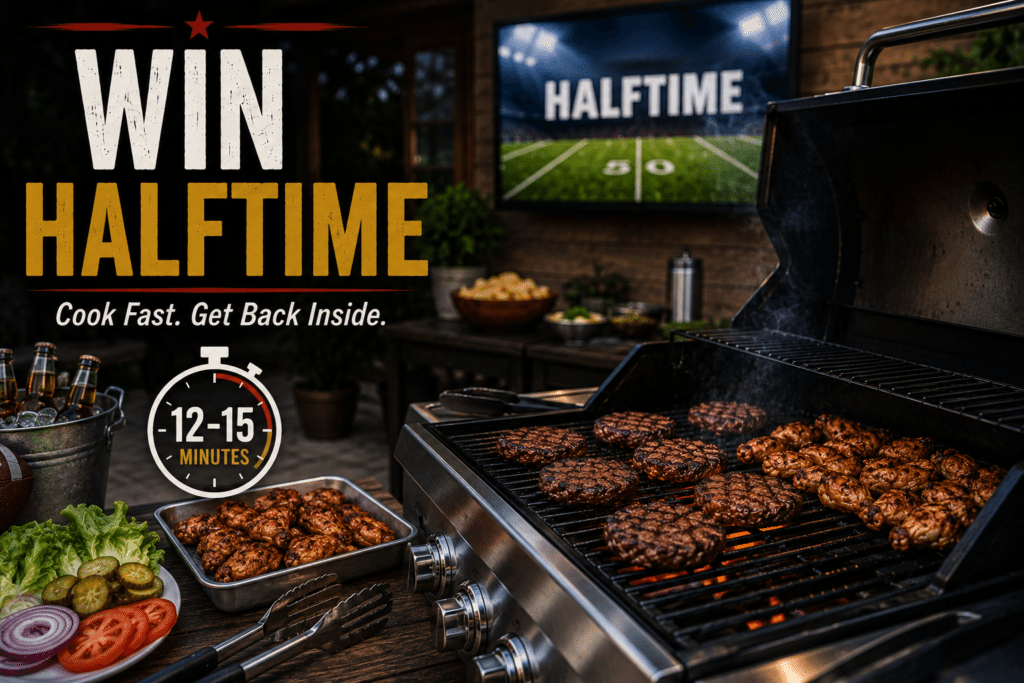
Halftime is your secret weapon.
Instead of cooking continuously through the game, use halftime as Wave Two.
This is an ideal time for:
- Fresh smashburgers
- Second wing batch
- Sausages
- Toasted buns
- Steak bites
- Hot appetizers
You already completed all the prep.
That means halftime cooking should be fast.
The goal is to finish before play resumes.
Third Quarter — Shut It Down
At this point, most of the serious cooking should be finished.
Turn off equipment that is no longer necessary.
Move food to appropriate storage or holding conditions.
Get back to the game.
Fourth Quarter — Bourbon and Cigar Territory
If you choose to drink or smoke, the late game is where the Bathrobe Patriot setup comes together.
Food has been served.
Knives are put away.
The grill is winding down.
The game is close.
Pour something reasonable.
And if cigars are part of your Sunday, my Best Cigars for Football Sunday guide covers 15 game-day options ranging from shorter halftime smokes to fuller night-game cigars.
That is a much better fourth-quarter assignment than washing sheet pans.
How to Adjust the Grilling Timeline for Different Kickoff Times
The beauty of this system is that you do not need a completely different plan.
Move the schedule.
Noon College Football Kickoff
Friday and Saturday prep becomes especially important.
Aim for:
9:00 AM: Cold prep
9:30 AM: Equipment setup
10:30 AM: Preheat
11:00 AM: Start cooking
11:45 AM: Food out
Noon: Kickoff
Coffee may be more useful than bourbon at this stage of the operation.
1:00 PM NFL Kickoff
Use the full schedule in this article.
This is probably the easiest football meal window.
You have all morning to prepare and can still enjoy the afternoon.
4:00–4:30 PM Kickoff
This is arguably the best grilling window.
Prep around lunch.
Start cooking around 2:30–3:00 PM.
Serve around 3:45–4:00 PM.
You get afternoon sunlight, plenty of prep time, and dinner can essentially become the game-day meal.
Sunday Night Football
Do not spend the entire afternoon cooking.
Prep earlier.
Relax.
Begin your main grilling window around two hours before kickoff.
For a night game, I prefer food that feels slightly more substantial:
- Steak
- Steakhouse burgers
- Smoky wings
- Sausages
- Grilled vegetables
Night games also make more sense for richer bourbon and fuller cigars than an early kickoff.
Football Grilling Timeline by Food
Here is the easiest way to plan a mixed menu.
| Food | Prep Ahead? | Best Cooking Window |
|---|---|---|
| Smashburgers | Portion ahead | 15–30 min before serving |
| Thick burgers | Form ahead | 30–45 min before |
| Wings | Season ahead | 45–60 min before |
| Steak | Basic prep ahead | Close to serving |
| Sausage | Yes | 30–45 min before |
| Hot dogs | Yes | 10–20 min before |
| Grilled vegetables | Cut ahead | 20–40 min before |
| Bacon | Yes | Before main burger cooking |
| Chili | Absolutely | Hours/day ahead |
| Pulled pork | Yes | Finish well before kickoff |
| Dips | Usually | Day before/morning |
| Burger toppings | Yes | Morning/day before |
This table is the part of the article I want people to remember:
The closer a food gets to being ruined by sitting around, the closer to serving time you should cook it.
Burgers: Cook Them Late
Burgers are not crock-pot food.
A great smashburger goes downhill as it sits.
So do not make your burgers at 11:15 and hold them until a 1:00 game.
Do all the prep early.
Do the cooking late.
And use a thermometer rather than relying entirely on color. USDA guidance lists 160°F as the safe minimum internal temperature for ground meats, including ground beef.
USDA Safe Minimum Internal Temperature Chart
Chicken Wings: Start Earlier
Wings are more forgiving.
They also generally require longer cooking.
That makes them an excellent first item.
For poultry, including chicken wings, USDA lists 165°F as the safe minimum internal temperature.
Cook them through safely, then use high heat where appropriate to develop the crisp skin you want.
That can mean:
- Hot oven
- Air fryer
- Grill
- Smoker followed by high heat
- Pellet grill followed by a hotter finish
No deep fryer required.
Steak: Don’t Ruin It by Holding It Forever
Steak belongs near serving time.
If steak is your football centerpiece, prep everything else first.
Cook the steak.
Rest it appropriately.
Slice if desired.
Serve.
For whole beef steaks, USDA lists 145°F followed by at least a three-minute rest as its safe minimum.
That is different from ground beef, which is why a food thermometer belongs in your game-day equipment.
The Most Important Game-Day Tool Isn’t the Grill
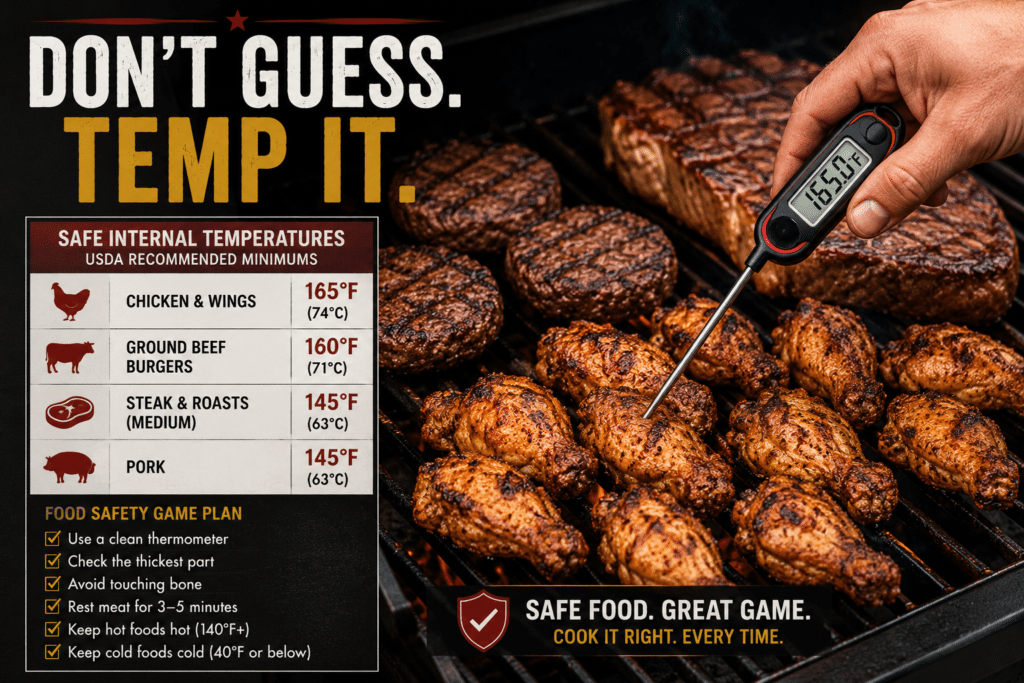
It is an instant-read thermometer.
Football parties are terrible environments for guessing.
You are distracted.
People are talking.
The television is on.
Someone wants you to look at a replay.
Different pieces of meat have different thicknesses.
Use the thermometer.
The USDA’s basic minimum-temperature guidance includes:
- Ground beef: 160°F
- Poultry and chicken wings: 165°F
- Whole beef steaks/chops/roasts: 145°F plus a three-minute rest
- Leftovers: 165°F when reheating
You can cook food further according to preference, but those safety minimums give you a reliable baseline.
How to Keep Football Food Safe During a Long Game
Football gatherings create another problem:
Food sits around.
A game can last more than three hours. Add pregame and postgame time and you can easily have food sitting outside for half the day.
That is not the plan.
USDA guidance says perishable food should generally not remain unrefrigerated for more than two hours, or one hour when temperatures are above 90°F.
That second rule matters particularly for outdoor football parties in hot climates.
Do not put every piece of food you own outside at kickoff.
Serve smaller batches.
Keep cold food cold.
Keep hot food appropriately hot.
Refrigerate leftovers promptly.
This is another reason the two-wave cooking system works so well.
Fresh food tastes better and spends less time sitting around.
The Two-Wave Football Cooking System
If you remember nothing else from this football weekend grilling timeline, remember this.
Wave One: Pregame
Cook enough food for:
- Guests who arrived early
- Kickoff
- First quarter
Wave Two: Halftime
Cook:
- Fresh burgers
- Fresh wings
- Remaining sausages
- Whatever the crowd actually needs
This prevents:
- Overcooking
- Food waste
- Cold burgers
- Soggy wings
- Food sitting outside for hours
And it gives you a natural cooking window when the game is not being played.
What NOT to Cook During Football Sunday
There is a point where ambition becomes stupidity.
If you are hosting a large group, avoid building a menu where every dish requires last-second attention.
You probably do not need:
- Three different steaks cooked to five different temperatures
- Seven burger varieties
- Four hot side dishes
- Made-to-order eggs
- Complicated fried food
- Anything requiring you to stand inside whisking a sauce during the fourth quarter
Pick food that works with the event.
This is why burgers and wings are football classics.
They scale.
They can be prepared in batches.
People understand them.
And they taste good.
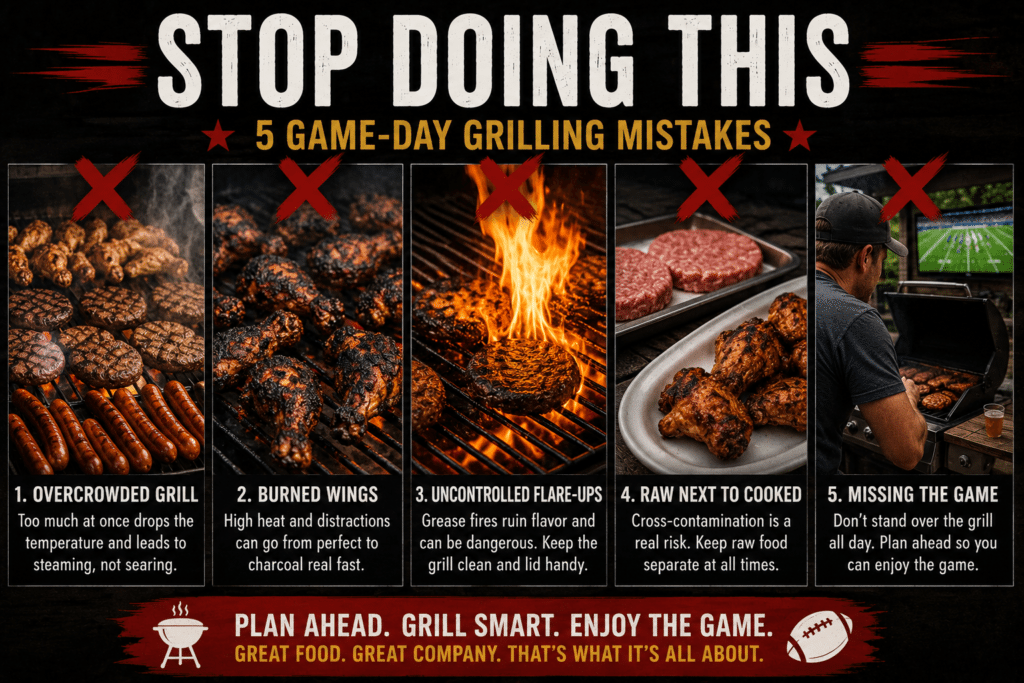
Common Football Grilling Mistakes
Starting Too Late
This is the biggest one.
Kickoff is not when you should begin thinking about food.
Cooking Everything at Once
Different foods require different temperatures and different cooking times.
Stagger them.
Overcrowding the Grill
More food does not automatically mean faster service.
Crowding often reduces heat and makes cooking less predictable.
Constantly Opening the Grill
Every time you open a covered grill, you change the cooking environment.
Stop checking it every 45 seconds.
Using One Pair of Tongs for Everything
Keep raw-meat utensils separate from cooked-food utensils.
Guessing Doneness
Use a thermometer.
Putting Everything Out at Kickoff
Football lasts hours.
Serve food in waves.
Making Too Much Food
A football party does not need to resemble a casino buffet.
Choose fewer things and cook them better.
How I Would Build the Simplest Football Sunday Menu
If I wanted maximum game-day impact with minimum work, I would serve:
Main
Classic smashburgers.
Second Main
Two flavors of dry-rub wings.
One mild.
One spicy.
Sides
Grilled vegetables and a cold chopped salad.
Snack
Guacamole with vegetables.
Drinks
Water, sparkling water, whatever nonalcoholic drinks people want, plus an optional bourbon setup for adults who choose to drink.
Later
Cigars for adults who already smoke and choose to participate.
That is plenty.
You do not win football Sunday because you made 19 different foods.
You win because the food was good and you actually got to enjoy the people eating it.
Football Weekend Grilling Timeline FAQ
How early should I start grilling before a football game?
For most burgers, wings, sausages, and traditional game-day food, begin your main cooking window approximately 45 to 90 minutes before kickoff, depending on the menu. Complete chopping, seasoning, sauces, dips, and other preparation several hours earlier or the day before.
What food should I cook first for a football party?
Start with foods requiring the longest cooking time. Wings, larger cuts of meat, slow-cooked foods, and dense vegetables generally go before quick-cooking items such as smashburgers, hot dogs, and toasted buns.
When should burgers go on the grill before kickoff?
For most football parties, begin burgers roughly 20 to 40 minutes before you want people eating, depending on burger thickness, grill capacity, and number of batches. Smashburgers should be cooked especially close to serving.
Can I make football food the day before?
Many components can be prepared the day before, including dry rubs, dips, sauces, cut vegetables, burger toppings, portioned burger meat, and seasoned wings. Foods that depend on fresh texture—particularly smashburgers and toasted buns—are better cooked shortly before serving.
How do I grill for a large football crowd?
Cook in batches rather than overcrowding the grill. Prepare ingredients ahead, establish a self-service serving area, cook a first wave before kickoff, and use halftime for a second hot-food wave.
What is the easiest food to grill for football Sunday?
Burgers, sausages, hot dogs, chicken wings, and grilled vegetables are among the easiest choices because they can be prepared ahead and cooked in manageable batches.
How do I keep burgers warm during a football party?
The better strategy is usually to cook smaller batches rather than holding every burger for a long period. Have one batch ready around kickoff and prepare another at halftime when necessary.
How do I avoid missing the football game while grilling?
Complete virtually all chopping, portioning, seasoning, cold dishes, and equipment setup before the main cooking window. Aim to have the first food ready 15 to 30 minutes before kickoff and reserve halftime for any second batch.
What temperature should burgers reach?
USDA guidance recommends cooking ground meat to a safe minimum internal temperature of 160°F, measured with a food thermometer.
What temperature should chicken wings reach?
USDA guidance lists 165°F as the safe minimum internal temperature for poultry, including chicken wings.
How long can football food sit outside?
USDA guidance recommends refrigerating perishable food within two hours, or within one hour when the temperature is above 90°F.
The Bathrobe Patriot Football Sunday Formula
Here is the entire article condensed into ten rules:
- Plan Friday.
- Shop Saturday.
- Prep Saturday.
- Organize Sunday morning.
- Make cold food first.
- Start long-cooking food first.
- Cook burgers close to serving.
- Have Wave One ready before kickoff.
- Use halftime for Wave Two.
- Sit down and watch the damn game.
That is your football weekend grilling timeline.
It does not need to be more complicated than that.
Final Verdict: Cook Less During the Game
The best football host is not necessarily the guy with the biggest grill.
It is the guy who planned well enough that he does not have to stand in front of it for four hours.
Prepare your ingredients early.
Make the rubs Saturday.
Cut the vegetables.
Portion the burgers.
Set up the serving area.
Start the long-cooking food first.
Cook burgers late.
Serve the first wave before kickoff.
Use halftime for the second.
Then stop cooking.
Grab a plate.
Sit down.
Watch football.
Because if everybody else remembers how good your burgers were but you cannot remember the final score, your game-day cooking schedule needs work.
Good food should make football weekend better—not prevent you from enjoying it.
That is the entire point of the Bathrobe Patriot Football Weekend Playbook.
GET THE FRIDAY FOOTBALL WEEKEND PLAYBOOK

Eric Webber is the founder of Bathrobe Patriot, a lifestyle brand centered on bourbon, cigars, and common sense. As an ISSA-certified trainer and former restaurant owner with 20 years of experience, he values quality over quantity and backbone over political correctness. Currently, Eric lives in Safety Harbor, Florida, where he advocates for a life of balance, discipline, and the occasional slow pour. Consequently, his mission is to provide you with the unfiltered truth about the gear, spirits, and culture that define the American spirit.