
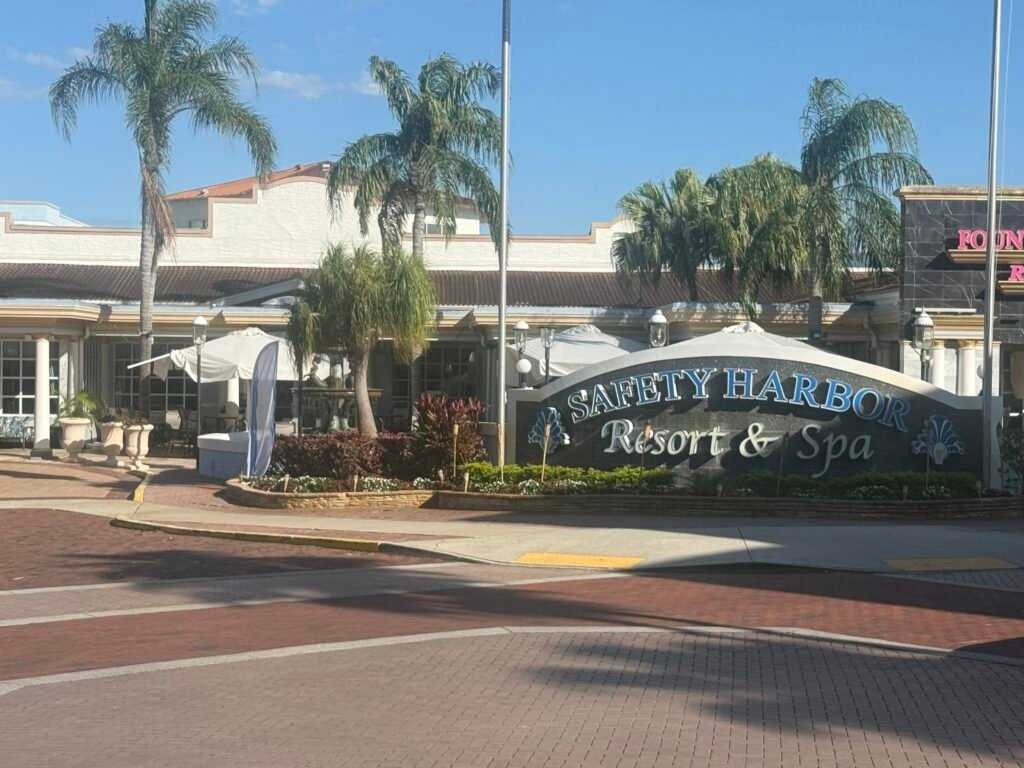
At the east end of Main Street in Safety Harbor sits a sprawling waterfront resort built around something much older than the hotel itself:
natural mineral springs.
Long before Safety Harbor had boutiques, restaurants, Third Friday crowds or even its modern name, people were drawn to the waters along this part of Old Tampa Bay.
Over time, those springs became surrounded by Native American history, Spanish exploration stories, health claims, tourism, sanitariums, entrepreneurs and one of the most recognizable landmarks in Safety Harbor.
Today, the Safety Harbor Resort & Spa is still operating on the waterfront, still using water from the springs, and still serving as one of the defining landmarks of the city.
But its history is more complicated—and considerably more interesting—than the simple “Fountain of Youth” story.
Here’s how it happened.
Quick Answer: How Old Is the Safety Harbor Resort & Spa?
The answer depends slightly on what you mean by “the resort.”
The Safety Harbor Resort & Spa currently markets itself as “The Heart of Safety Harbor Since 1924.” Its own spa history, however, says a natural mineral springs spa was established at the site in 1925, and Visit St. Pete-Clearwater likewise lists the resort as founded in 1925.
The important distinction is that the springs and their importance to the area are far older than the modern resort.
The property evolved through different owners, buildings, health facilities and resort concepts before becoming the Safety Harbor Resort & Spa we recognize today.
So rather than getting hung up on whether the birthday cake should say 1924 or 1925, it’s more useful to understand that the modern resort story is now roughly a century old—and the story of the springs goes back much further.
Safety Harbor Resort History at a Glance
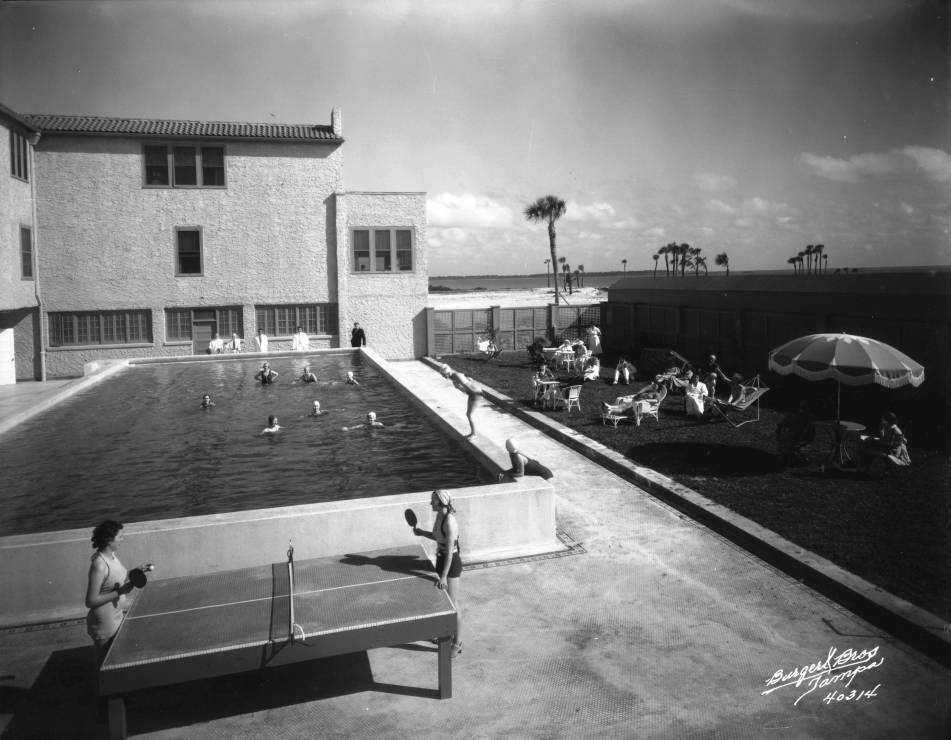
Location: 105 North Bayshore Drive, Safety Harbor, Florida
Modern resort era: Approximately 1924–1925 to today
Built around: Natural mineral springs traditionally known as the Espiritu Santo Springs
Major historical figures: The Tucker family and Dr. Salem Baranoff
Known for: Mineral springs, health and wellness tourism, spa treatments and its waterfront location
Historic recognition: The resort says the U.S. Department of the Interior recognized the property as a Historical Landmark in 1964 and that it became a Florida Heritage Landmark in 1997.
Today: 172 guest rooms and a 50,000-square-foot spa and fitness facility.
But the story doesn’t begin with a hotel.
It begins with the land and the water.
Before the Resort: The Tocobaga and the Springs
To understand why a resort eventually appeared here, you have to go back centuries before Safety Harbor existed as a modern city.
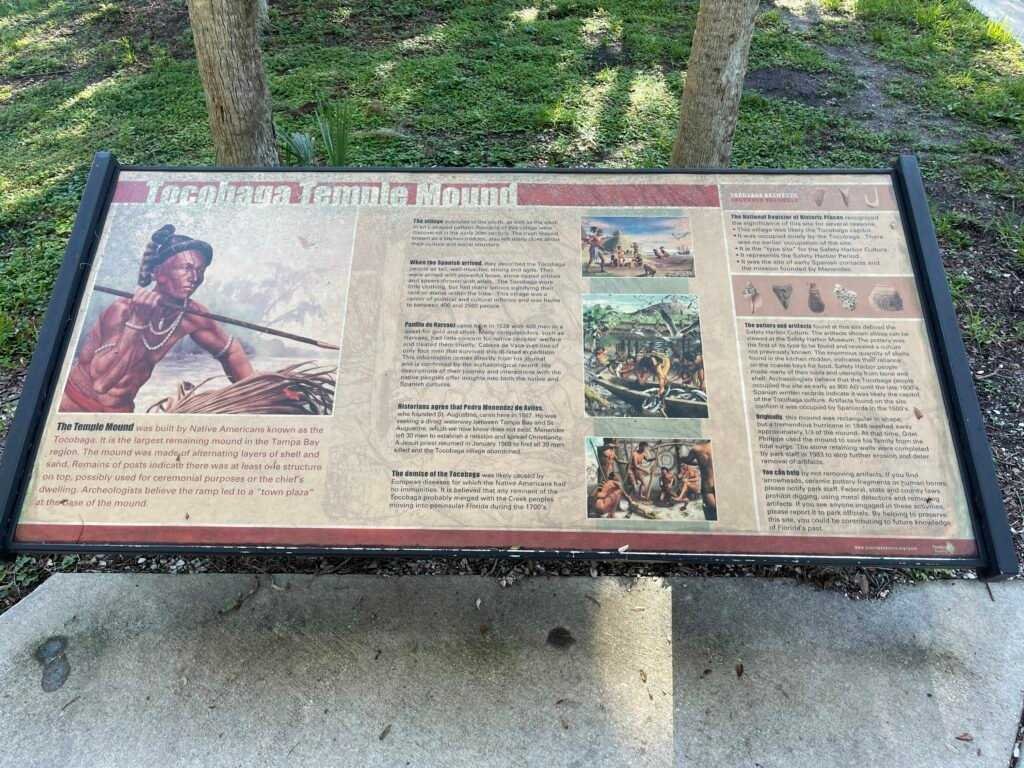
The Tampa Bay region was home to Indigenous communities long before European exploration. The Tocobaga are particularly associated with the northern Tampa Bay area and what is now Safety Harbor.
Evidence of that history remains nearby at Philippe Park, home to the largest remaining Native American mound in the Tampa Bay region.
That archaeological site is one of the clearest reminders that people were living around these waters long before hotels, sanitariums and spa treatments arrived.
If you want to explore that part of the story in person, see my Philippe Park Safety Harbor guide, including the Tocobaga Temple Mound, walking, fishing, parking and what to see during a visit.
You can still see an important piece of that earlier history just a few minutes away. My Philippe Park Safety Harbor guide covers the Tocobaga Temple Mound, waterfront, parking, walking, fishing and what to see during a visit.
The mineral springs eventually became part of another story, however.
And this one involved Spanish explorers, a legendary fountain and a lot of Florida mythology.
The resort is only one chapter of a much larger story. For the broader timeline—from the Tocobaga and early settlement through the development of the modern city—read my complete history of Safety Harbor, Florida.
Did Hernando de Soto Discover the Safety Harbor Springs?
This is where history and legend start getting tangled together.
The traditional story says Spanish explorer Hernando de Soto reached the area in 1539, encountered the natural springs and associated them with the legendary search for restorative waters.
The Safety Harbor Resort itself says de Soto discovered the springs in 1539 and later named them Espiritu Santo Springs. Visit Florida also repeats the traditional account connecting de Soto with the springs and the legendary Fountain of Youth.
You’ll still encounter that story throughout Safety Harbor.
But I think it’s better to treat it as long-standing local tradition rather than turn every detail of the legend into unquestioned historical fact.
What isn’t in doubt is more important:
The springs became central to Safety Harbor’s identity.
And eventually people figured out they could build a business around them.
The Mineral Springs That Built Safety Harbor
Before bottled water became something you bought at a gas station for $3, mineral springs were destinations.
Across the United States and Europe, people traveled to natural springs and health resorts because the water was believed to possess restorative or medicinal properties.
Safety Harbor became part of that tradition.
The springs here eventually became known as Espiritu Santo Springs, and promoters attributed all kinds of health and rejuvenating qualities to the water.
Those beliefs became enormously important to the development of the property.
They helped transform a natural feature into a destination.
Did the Safety Harbor Springs Really Have Healing Powers?
This is where we need to separate historical marketing from modern medical fact.
For generations, promoters and visitors attributed restorative properties to mineral-spring water.
The Safety Harbor Resort continues to build its wellness identity around the natural mineral springs today and uses spring water in pools and spa experiences.
But historical claims that spring water could cure diseases or restore youth shouldn’t be treated as established medical science.
They’re important because people believed them—and those beliefs helped build Safety Harbor.
That’s the fascinating part.
How the Springs Became a Destination
By the early 20th century, Safety Harbor was changing.
Florida tourism was expanding.
Railroads, automobiles and growing interest in health resorts created opportunities in places that previously had been difficult for travelers to reach.
The springs offered something marketable:
Florida weather.
Waterfront scenery.
Natural mineral water.
Health and relaxation.
That combination eventually produced the spa destination that would define the eastern end of Main Street.
The modern resort traces its roots to the 1924–1925 period, although, as noted earlier, contemporary sources don’t all use precisely the same founding year.
What matters is what happened next.
Safety Harbor was becoming known for its waters.
The Sanitarium Era
The resort didn’t always look—or operate—like the hotel and spa you see today.
Earlier iterations of the property reflected the health-resort culture of their era.
Even the terminology was different.
Historical records preserved by the City of Safety Harbor refer to the property over time as the Espiritu Santo Springs Pavilion, Safety Harbor Sanatorium and Safety Harbor Spa.
That’s an important clue to understanding the place.
People weren’t necessarily coming here simply for a Florida vacation.
The property was connected to the broader early-20th-century idea that rest, climate, bathing, mineral water and specialized health facilities could improve physical well-being.
Eventually, another major figure entered the story.
Dr. Salem Baranoff and the Safety Harbor Spa
If you’ve spent any time around downtown Safety Harbor, you’ve probably seen the name Baranoff.
There’s Baranoff Park.
There’s the famous Baranoff Oak.
And the name is deeply connected to the resort’s history.
Dr. Salem Baranoff purchased the Safety Harbor Spa during the 1940s. The City of Safety Harbor’s library history says Baranoff had just purchased the Safety Harbor Spa in 1946 when he learned that the growing community needed land for a new library.
He bought two lots at the corner of 2nd Street North and 5th Avenue North and donated the land for the new library. Groundbreaking took place in 1949.
That’s why Baranoff’s legacy in Safety Harbor extends well beyond the resort.
He became part of the civic history of the city itself.
The City still specifically identifies Dr. Salem Baranoff (1886–1977) as one of the important figures whose photographs and historical material it seeks to preserve.
The Baranoff Oak
There’s another piece of the Baranoff story you can still see downtown.
The Baranoff Oak stands in Baranoff Park, only a short walk from the resort.
It’s one of those places that’s easy to walk past without understanding why the name matters.
Once you know the relationship between Baranoff, the spa and Safety Harbor’s civic history, the pieces start connecting.
That’s one of my favorite things about Safety Harbor.
The history isn’t locked away inside one museum.
It’s scattered around town.
You just need to know what you’re looking at.
How the Safety Harbor Resort Changed Over the Decades
The property continued evolving from health facility into a larger resort and spa destination.
Buildings changed.
Ownership changed.
The surrounding city grew dramatically.
Health and wellness culture changed too.
But the central marketing idea remained remarkably consistent:
the water.
Even today, the resort describes itself as Florida’s only natural mineral springs spa and says its pools and spa experiences use water associated with the Espiritu Santo Springs.
That’s a pretty remarkable through-line.
A concept that attracted visitors generations ago is still part of the property’s identity today.
Is the Safety Harbor Resort a Historic Landmark?
The resort says the U.S. Department of the Interior recognized and designated the Safety Harbor Resort and Spa a Historical Landmark in 1964, followed by designation as a Florida Heritage Landmark in 1997.
Visit St. Pete-Clearwater likewise describes it as both a U.S. Historic Landmark and Florida Heritage Landmark.
The City of Safety Harbor also treats the property as central to the community’s historical identity.
Its planning documents describe the Safety Harbor Resort and Spa as a cornerstone of the city’s identity and reputation as an international resort destination, with the surrounding Destination Resort district intended to preserve the property’s historic hotel and resort function.
In other words, this isn’t simply an old hotel that happens to still be operating.
It’s part of the identity of Safety Harbor itself.
Can You Still Experience the Mineral Springs Today?
Yes.
That’s one of the coolest parts of the story.
The mineral-springs identity isn’t merely something displayed on an old photograph in the lobby.
The Safety Harbor Resort says spring water continues to be used throughout its spa facilities, including its pools and mineral-bath treatments.
The spa currently offers an Espiritu Springs Mineral Bath, along with other treatments incorporating the mineral-bath experience.
So you can read about a century of spa history and then experience a modern version of the same concept.
Just don’t expect me to promise it’ll make you 25 again.
Do You Have to Stay at the Hotel to Use the Spa?
No.
You don’t necessarily need to book an overnight stay to experience the spa.
The resort offers day spa services, and its current policy says guests booking spa services can use resort amenities and facilities for the day. Advance reservations are required for spa services.
That makes the resort relevant even for locals who have absolutely no reason to rent a hotel room five minutes from their house.
You can experience the property without turning it into a vacation.
Safety Harbor Resort & Spa official website
Is the Safety Harbor Resort Haunted?
Spend enough time around an old hotel, sanitarium or spa and eventually somebody will tell you there’s a ghost.
Safety Harbor Resort is no exception.
Stories about unusual experiences and paranormal activity have circulated around the property over the years.
They’re fun.
They’re part of local folklore.
But that’s where I’d leave them.
I haven’t found reliable evidence that proves the Safety Harbor Resort is haunted.
If you enjoy ghost stories, enjoy them.
Just don’t confuse a good story with documented history.
Frankly, the real history of the place is interesting enough without needing a ghost to walk through the lobby.
What Is the Safety Harbor Resort & Spa Like Today?
Today, the resort is substantially larger and more conventional than the early health facilities that once occupied the site.
The resort currently advertises:
172 guest rooms
a 50,000-square-foot spa and fitness center
30 treatment rooms
three swimming pools
more than 30,000 square feet of meeting and convention space
plus dining, weddings, events and waterfront accommodations.
But despite all of that, its location is still one of its biggest advantages.
Walk out the front of the resort and you’re basically at the end of Main Street.
Walk behind it and you’re at the waterfront.
That’s difficult to duplicate.
If you’re staying into the evening, the resort also makes an easy starting point for a night downtown. My Safety Harbor date night guide covers some of my favorite options for dinner, drinks and an easy walk around Main Street.
Why the Resort Matters to Downtown Safety Harbor
This is where I think the history becomes more interesting than simply memorizing dates.
Imagine downtown Safety Harbor without the resort sitting at the end of Main Street.
It changes the whole identity of the place.
The resort helped establish Safety Harbor as a destination long before today’s restaurants, breweries, boutiques and festivals arrived.
And today it sits directly beside the walkable downtown that grew around it.
That’s why the City itself describes the resort as a cornerstone of Safety Harbor’s identity.
The relationship works both ways now.
Resort visitors walk into downtown.
Downtown visitors walk toward the waterfront and resort.
And monthly events bring thousands of people onto Main Street.
If you’re planning to visit during one of those nights, see my complete Safety Harbor Third Friday guide for current dates, parking, live music, food and what to expect.
That relationship between the resort and downtown is especially obvious during Safety Harbor Third Friday, when Main Street becomes a nine-block evening event with live music, food, drinks and local businesses. My Safety Harbor Third Friday guide has the current dates, parking strategy and what to expect.
What Else to See Near the Safety Harbor Resort
The nice thing about exploring this history is that several related sites are nearby.
Philippe Park and the Tocobaga Temple Mound
This should be your first stop if the Native American history interests you.
Philippe Park contains the largest remaining mound in the Tampa Bay region and gives you a much better physical sense of how long people have lived around these waters.
Philippe Park Safety Harbor Guide
Baranoff Park
Walk into downtown and see the Baranoff Oak.
Once you’ve read about Dr. Baranoff’s role at the spa and in the community, the name means considerably more.
Walk Main Street
The resort sits at the eastern end of downtown, making it easy to combine the historical stop with food, drinks and shopping.
If you’re visiting on a Sunday, check whether Safety Harbor Market on Main is happening while you’re there.
Visiting on a Sunday? Check my Safety Harbor Market on Main guide before heading downtown to see when the market runs, what you’ll find and how to combine it with a morning around Safety Harbor.
Explore More Safety Harbor History
The City and Safety Harbor Public Library maintain extensive local-history collections, including historic newspapers, photographs and documents.
The library’s Safety Harbor Herald collection alone contains more than 1,500 searchable issues dating from 1919 through 1989.
Safety Harbor Local History Collection
Safety Harbor Resort & Spa History FAQ
How old is the Safety Harbor Resort & Spa?
The modern resort traces its beginnings to approximately 1924–1925. The resort currently markets itself as serving Safety Harbor since 1924, while its spa page and Visit St. Pete-Clearwater describe the spa/resort as established or founded in 1925.
Where is the Safety Harbor Resort & Spa?
The resort is located at 105 North Bayshore Drive in Safety Harbor, Florida, at the eastern end of downtown Main Street overlooking Old Tampa Bay.
What are the Espiritu Santo Springs?
The Espiritu Santo Springs are natural mineral springs located at the resort property. They became associated historically with health and rejuvenation claims and remain central to the resort’s spa identity today.
Did Hernando de Soto discover the Safety Harbor springs?
Local tradition and the resort’s history connect Hernando de Soto with the springs in 1539. Because some details surrounding Florida’s early exploration stories have become intertwined with legend, I prefer to describe the de Soto connection as a traditional historical account rather than overstate what can be proven.
Is the Safety Harbor Resort really built over natural springs?
Yes. The resort says its property is built on the site of natural mineral springs and continues to use spring water in its spa facilities, pools and mineral-bath experiences.
Who was Dr. Salem Baranoff?
Dr. Salem Baranoff was a physician and owner of the Safety Harbor Spa during the mid-20th century who also became involved in the community. City history records that he donated land for a new Safety Harbor library after purchasing the spa.
Is Safety Harbor Resort & Spa a historic landmark?
The resort says it received U.S. Department of the Interior Historical Landmark recognition in 1964 and became a Florida Heritage Landmark in 1997. Regional tourism authorities also describe it as a historic landmark property.
Can you visit the Safety Harbor Spa without staying at the hotel?
Yes. The resort offers spa services to day visitors. Advance reservations are currently required for spa services.
Is the Safety Harbor Resort haunted?
There are paranormal stories associated with the historic property, but those should be treated as local folklore rather than documented historical fact.
Can you drink the mineral water?
The resort says mineral water is available at water stations throughout the property.
Final Verdict: Why the Safety Harbor Resort Still Matters
The Safety Harbor Resort & Spa is easy to misunderstand if you only see it as a big old hotel at the end of Main Street.
It’s much more interesting than that.
The story begins with natural springs and the people who lived around these waters long before modern Safety Harbor existed.
Then came explorers and legends.
Promoters and health claims.
Sanitariums and spa culture.
The Tucker era.
Dr. Baranoff.
Hotels, pools, treatments and generations of visitors.
Somewhere along the way, the resort became inseparable from the identity of Safety Harbor itself.
And that’s what I find most interesting.
You can still stand on Main Street today, look toward the waterfront and see the same basic relationship that made the location valuable generations ago:
the town, the water and the springs all meeting in one place.
The supposed Fountain of Youth?
I’ll leave that one to the legends.
But a century-old Florida resort still operating around the natural springs that helped put its hometown on the map?
That’s interesting enough without embellishing it.

Eric Webber is the founder of Bathrobe Patriot, a lifestyle brand centered on bourbon, cigars, and common sense. As an ISSA-certified trainer and former restaurant owner with 20 years of experience, he values quality over quantity and backbone over political correctness. Currently, Eric lives in Safety Harbor, Florida, where he advocates for a life of balance, discipline, and the occasional slow pour. Consequently, his mission is to provide you with the unfiltered truth about the gear, spirits, and culture that define the American spirit.
Safety Harbor Spa has greater depth than being well placed, on Tampa Bay. After Dr. Barnoff purchased the property, it was renovated and became a favorite vacation spot for the Jewish people of New York.
At that time, many places in the United States banned Jews, and though there was no specific banning of non-Jews, it was understood that this was a place where people could go and just be themselves.
I was fortunate enough to be in the area in the spring of 1969. My husband was in Vietnam. I was unable to find long-term employment because of his deployment, however, I worked for three months in the spring of 1969.
At that time, the spa had a medical center, with three different doctors to help process the guests. Upon arrival, each guest saw Doctor Gunner, Dr. diamond, and a tiny Jewish lady whose name escapes me. What did not and does not escape me is that she had been a prisoner of Auschwitz. She still carried the tattoo on her forearm that the Germans created for each prisoner.
Safety Harbor Spa was heralded as the location of the Fountain of Youth. In fact, and the bowels of the hotel, or four different drinking fountains. Each one was supposedly, specifically, different. When a guest saw their Doctor upon arrival, the doctor would prescribe number one, number two, number three, or number four water for them during their stay. They are assigned table during their visit would carry a picture of water in the middle of the table, that the doctor had prescribed upon arrival.
When I was interviewed for the job, I was interviewed by Salu Devnani, the hotel manager. He felt I was exactly the kind of person he wanted in the hotel, but had one more person to interview and could not tell me that I had the job. He told me that if I would call him in three days, he would be able to tell me whether or not I got the job.
I responded that in three days I would be over the Pacific Ocean, winding my way to see my husband for a week, as the military gave their soldiers a week away from the battles. So I told him that I could not call.
He asked:! You would like to be able to tell your husband that you have a new job, wouldn’t you!
Of course I agreed.
“Then when you get to Los Angeles airport, you call me collect, and I’ll tell you whether or not you got the job. “
I was flabbergasted at his kindness and generosity of heart. And and sure enough, when I arrived in Los Angeles, the call was made, and he assured me that I had been hired at Safety Harbor Spa.” and Mr.. Devnani was as good as his word. He hired me for three months in the medical division.
I met so many extraordinary people, many very wealthy, talented, well-known names, which remain familiar to the general public almost 60 years later.
In the late 1970s, I met Mr. Devnani going into a government building. I probably gushed, telling him how very much I appreciated his having me call him from the Los Angeles airport. That phone call is a gift that keeps on giving. just as, I am certain all the memories of the guest that stayed at the Spa as their special retreat.
Thank you for leaving this. A comment like this is the reason I write these Safety Harbor pieces.The 1969 medical intake, the numbered spring waters at the tables, Mr. Devnani taking a collect call from Los Angeles so you could tell your husband in Vietnam that you had the job — that is the kind of history that never makes it into the brochures. I am grateful you took the time to write it down.If you are comfortable with it, I would like to follow up and see whether a short “staff memory from 1969” section could be added to this article, with credit to you. No pressure either way. Either this stays as a comment that other readers can find, or it becomes part of the page. Your call.And if any other names or small details come back — the third doctor, what the medical division actually did day to day — I would be glad to hear them.
Good morning, Eric,
I’ve been terribly busy and regret that I haven’t gotten back with you earlier. I am delighted that someone is taking the time to save the history of what I consider a monument of shorts, in a small town of safety harbor.
Yes, I would like to add to incorrect some of the errors made (typos) in my first note.
I’ve come a long way, since 1969 (who hasn’t?)
While I was at the spa, I kicked myself because I did not write down what I observed. Since then, I learned to joy of language., If you read the Saint Pete Times, the Tampa Tribune,, the Suncoast News, or the Orlando Sentinel etc. You may have read my letters to the editor, and commentary.
I wrote one novel, one novel, “the Whitebridge Web “ but my love is still editorial and exquisite writing.
Looking at what I sent you, I would like to correct some typos in what I sent.
Can I send you a corrected item?
I have more than I can share with you about the history and the people that may flush out some of the blanks you may have presently
Best regards
please do! thanks for responding! Eric Bathrobe Patriot